
Why Every Second Counts in GBC Puzzle Speedrunning
A gbc puzzle speedruns guide is your fastest path to mastering retro puzzle games on the Game Boy Color – from learning basic category rules to executing frame-perfect inputs that shave seconds off your best times.
Quick-start overview for GBC puzzle speedrunning:
| What You Need | Details |
|---|---|
| Popular games | Pokemon Puzzle Challenge, Denki Blocks, Croc 2, Indiana Jones GBC |
| Main categories | Any% (fastest finish), 100%/Hundo (full completion) |
| Key tools | BizHawk emulator, TAS references, community leaderboards on Speedrun.com |
| Core techniques | RNG manipulation, frame-perfect inputs, pattern memorization, practice passwords |
| Where to start | Pick one game, study its leaderboard, learn its practice passwords |
The Game Boy Color is a deceptively demanding speedrunning platform. Its puzzle games look simple on the surface. But underneath, they hide deep RNG systems, tight movement mechanics, and routing decisions that can make or break a run.
Take Pokemon Puzzle Challenge: the real-time Easy Mode record sits at just 3 minutes flat, yet manipulating the game’s RNG requires frame-perfect inputs – meaning you have roughly 1/60th of a second to act. Or consider Croc 2, where a full 100% run demands careful crystal farming, with optimal grinding cycles clocking in at around 6 seconds per 5-crystal respawn in Sailor Village.
Battery life can also affect long practice sessions on original hardware. If you are drilling tight sequences for an hour or more, fresh batteries or a reliable power solution help keep your timing and visibility consistent.
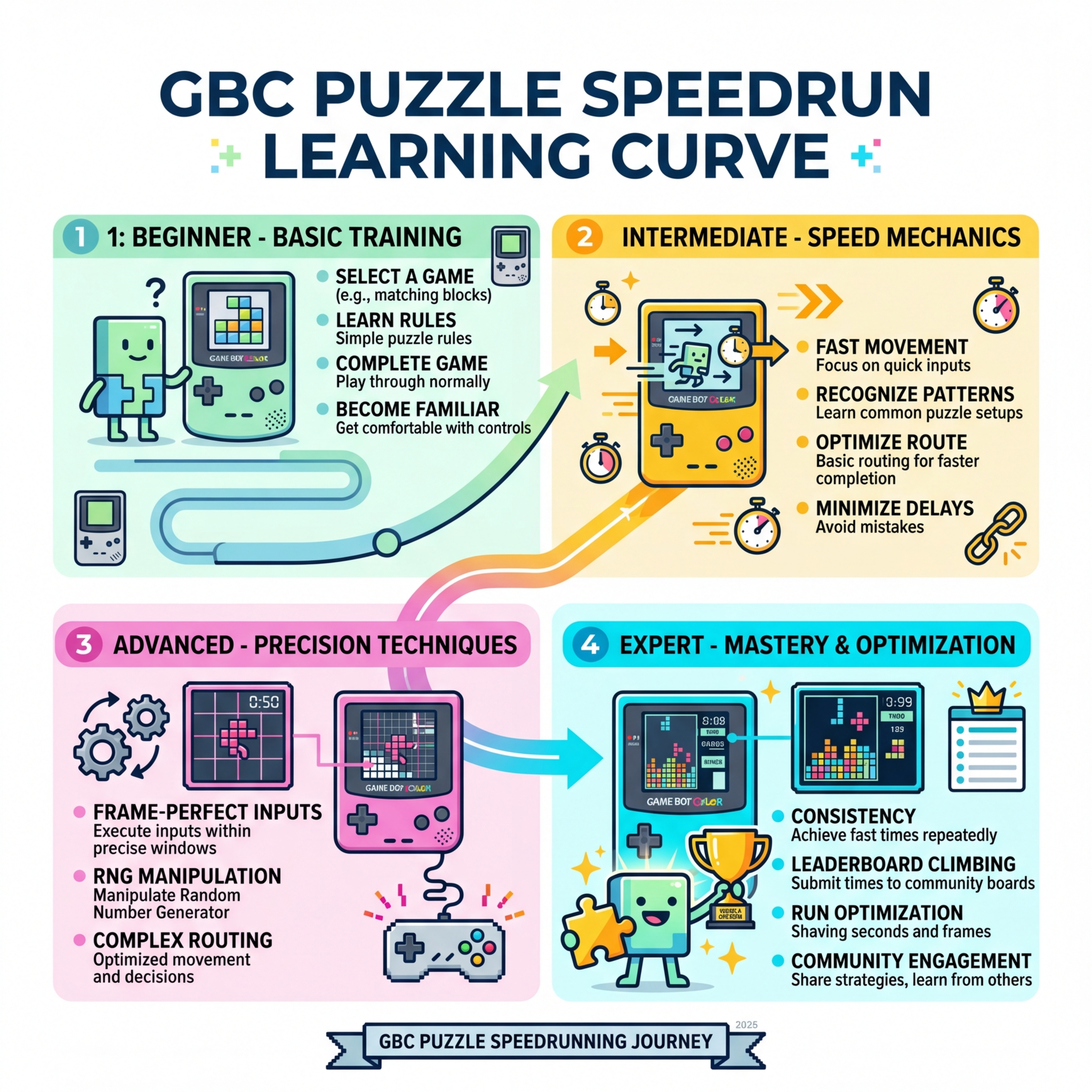
The Best GBC Puzzle Games for Speedrunning
When we dive into GBC speedrunning, we find that the puzzle genre is surprisingly diverse. It isn’t just about matching blocks; it involves adventure-puzzlers, logic-heavy brain teasers, and arcade ports.
Top Contenders for Your First Run
- Pokémon Puzzle Challenge: This is perhaps the most active community. It’s a port of Panel de Pon (or Tetris Attack) and is incredibly fast. With over 470 runs logged on Speedrun.com, it offers a competitive environment for those who love high-speed block swapping.
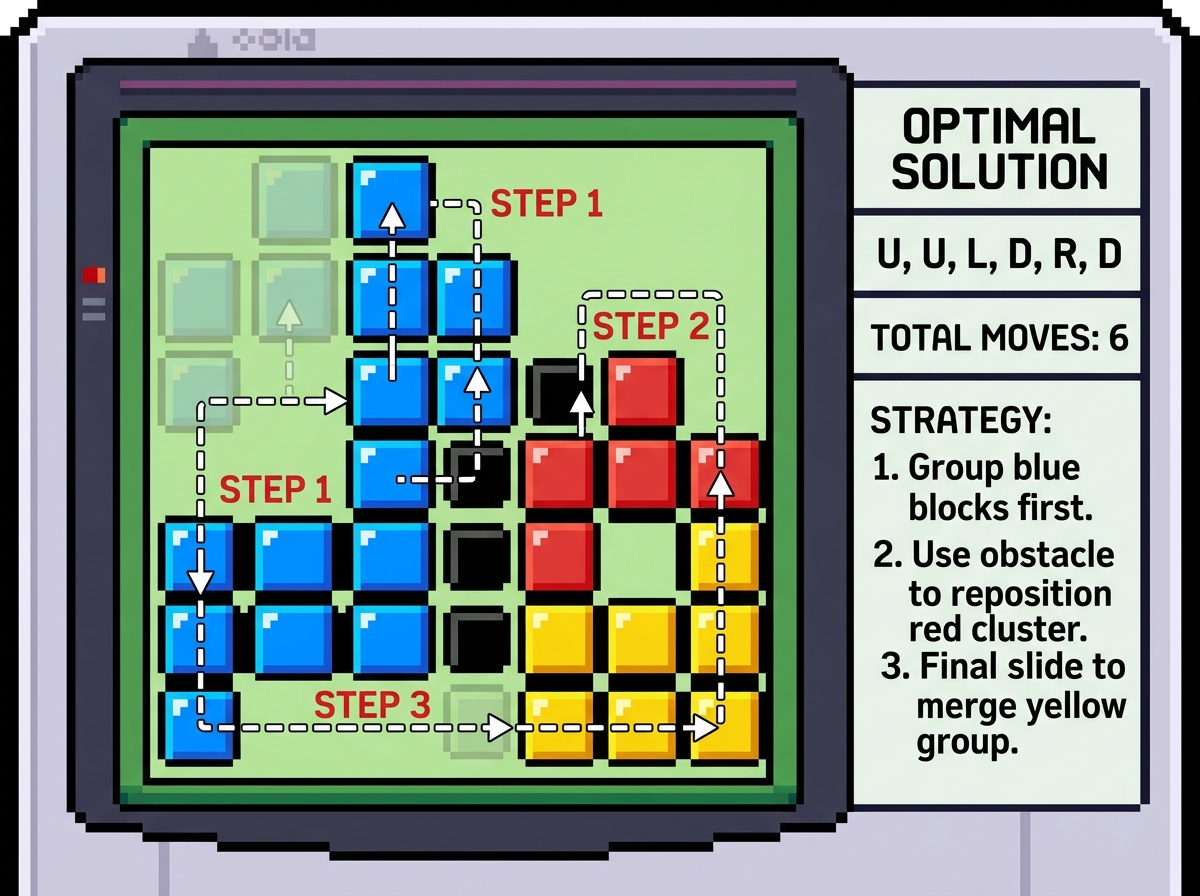
- Denki Blocks: If you prefer pure logic, this is the gold standard. It involves sliding sticky blocks to form shapes. The beauty here is the “optimal solution” culture—runners aim for the fewest moves possible.
- Puzznic: A Japanese-exclusive gem that finally received documentation after 20 years. It’s a gravity-based puzzler where you must clear blocks by matching them before they fall into unreachable spots.
- Hexcite: The Shapes of Victory: An obscure but brilliant geometry puzzler. Speedrunning this often involves beating the AI in the shortest time possible, which requires “chucking the big pieces” early to avoid being boxed in.
If you are looking for more variety, check out our guide on retro puzzle games for game boy or explore some hidden gems on game boy color to find a title that fits your playstyle.
Understanding Categories: Any% vs. 100% (Hundo)
In any gbc puzzle speedruns guide, you’ll encounter two main ways to play. Any% is a sprint to the credits. For a game like Indiana Jones and the Infernal Machine, this means skipping every optional treasure to hit the exit. In contrast, 100% (or Hundo) requires total completion. In Croc 2, a Hundo run means collecting every Golden Gobbo and farming enough crystals to buy every essential item.
| Game | Category | Average WR Time | Difficulty |
|---|---|---|---|
| Pokémon Puzzle Challenge | Easy Mode | ~3:00 | Extreme (RNG) |
| Denki Blocks | GBA Any% TAS | 29:47 | High (Logic) |
| Indiana Jones (GBC) | Level 5 Any% | 7:51 | Moderate (Movement) |
| Croc 2 (GBC) | Hundo | ~1:15:00+ | High (Resource Mgmt) |
Essential Techniques in a GBC Puzzle Speedruns Guide
To move from a casual player to a record-breaker, we need to look under the hood of the Game Boy Color hardware.
RNG Manipulation and RAM Addresses
Many GBC games use internal timers or button-press counts to determine “random” events. In Pokémon Puzzle Challenge, RNG is driven by RAM addresses like C38C and C38D. By mashing buttons at specific frames during the “Pikachu smile” opening or between stages, runners can force the game to give them easier block patterns. This is known as “manipulation,” and it turns a game of luck into a game of pure execution.
Frame-Perfect Inputs and Buffering
A “frame” on the GBC is roughly 1/60th of a second. Top-tier runs often require frame-perfect inputs. For example, in Gex: Enter the Gecko (GBC), preserving a “running state” is vital. If you stop moving, Gex loses momentum. Expert runners use input buffering—holding a button (like B for a tail bounce) before hitting the ground—to ensure the action triggers on the very first possible frame.
The Role of TAS (Tool-Assisted Speedruns)
We often look at TAS videos (hosted on sites like tasvideos.org) to see what is humanly possible. A TAS uses emulators like BizHawk to play the game one frame at a time with perfect accuracy. While we can’t replicate a TAS perfectly in real-time (RTA), we use them as “Theory Guides.” For instance, the Pokémon Puzzle Challenge Theory TAS shows that while a 3:00 run is the current human record, the game can technically be beaten even faster if every RNG check is manipulated perfectly.
Beginner Tips for Your GBC Puzzle Speedruns Guide
If you’re just starting, don’t worry about frame-perfect tricks yet. Focus on these fundamentals:
- Pattern Memorization: In games like Speedy Gonzales, levels scroll fast. You must memorize where the “question mark” signs are to activate platforms before you fall into a pit.
- Use Save States for Practice: When using an emulator, follow our using save states in emulators a how to guide to loop difficult sections like the Shambala Sanctuary bell jump until you have the muscle memory down.
- Learn the Cheats: Some games have built-in codes that help practice. In Pokémon Puzzle Challenge, pressing Left, A, B, Up when Pikachu smiles removes “combo pauses,” making the game move much faster for training.
- Cursor Speed: In menu-heavy games or block-movers like Puzznic, your cursor movement is your bottleneck. Practice the shortest paths between blocks.
Advanced Routing in Your GBC Puzzle Speedruns Guide
Routing is the “map” of your speedrun. It’s deciding exactly what to do and when to do it to save the most time.
Croc 2: Crystal Farming and GO Abuse
In Croc 2 (GBC), resource management is the name of the game. You need 120 crystals per world to buy the necessary Robo Gobbos and Jump Jellies.
- Optimal Grinding: The fastest spot is the Sailor Village Item Collection. You can grab a 5-crystal bundle, leave, and re-enter in about 6 seconds.
- GO (Game Over) Abuse: This sounds counter-intuitive, but dying on purpose can save time! After collecting a Golden Gobbo in a revisited level, forcing a Game Over can warp you back to the village hub faster than walking to the exit, though you must weigh this against the crystals you lose.
- Snowman Skip: This is the “Holy Grail” of Croc 2 runs. It requires a frame-perfect jump on ice with a 3-frame input window. If successful, it saves 2 minutes and 40 seconds, plus all the time you would have spent farming crystals for that level.
State Preservation
In Gex: Enter the Gecko, the game takes about a second of walking before Gex enters a full run. To save time, we use “oscillating”—tapping left and right quickly on small platforms—to keep Gex in a “running state” even when there’s no room to move. This ensures that the moment you have a straightaway, you’re already at top speed.
Mastering Specific Titles: From Denki Blocks to Indiana Jones
Denki Blocks: The Computer-Verified Route
For Denki Blocks, the community doesn’t just guess the best route; they use custom computer programs to find the minimal move solutions. For example, in the “First Ranking” puzzle group, 28 out of 30 puzzles have been solved with absolute mathematical optimality. When speedrunning this, your goal isn’t just to be fast with your hands, but to memorize these specific, computer-verified paths.
Indiana Jones: Shambala Sanctuary (Level 5)
Level 5 is often the “run killer” in Indiana Jones and the Infernal Machine.
- The Bell Jump: You must jump back and forth 7 times on broken tiles to position a bell. Listen for the specific sound cue; if you miss the timing, the bell falls, and the run is over.
- Statue Skip: During the statue cutscene, mashing the button 7-9 times is the “sweet spot.” It balances speed with the safety of hitting the red peg target.
- Ladder Snipes: GBC physics allow you to “snip” a ladder by jumping at its very edge pixels. This allows you to start climbing from a higher point, skipping several seconds of slow climbing animation.
Quest for Camelot and Puzznic Exploits
In Quest for Camelot, the controls are notoriously “horrible,” but you can exploit the double-tap sword technique to trigger door puzzles in Chapter 5 faster than intended. In Puzznic, an advanced technique involves releasing the A or B button mid-drag while a block is falling. This allows you to grab an adjacent block before the game finishes processing the first move, essentially “chaining” your actions.
Hardware vs. Emulation: Optimizing Your Setup
Should you play on an original handheld or a PC? Both have pros and cons.
The Case for Emulation (BizHawk)
Emulators like BizHawk are preferred for TAS and heavy practice. They offer consistent RAM initialization. On real hardware, the RAM might start with “junk” data that changes RNG. Emulators provide a clean slate. If you are a Mac user, check our guide on emulating game boy color games on a mac to get started.
Original Hardware and Input Lag
Nothing beats the feel of a real GBC, but be aware of game boy color troubleshooting tips regarding button responsiveness. Original hardware has zero display lag, which is crucial for the 3-frame windows in Croc 2. However, if you’re using a Game Boy Player on a GameCube, you might encounter slight lag that throws off your timing.
Performance Optimization
Whether you use hardware or software, you want the best performance. Check out our tips on optimizing your retro emulator for improved performance to ensure you aren’t dropping frames during a record attempt.
Frequently Asked Questions about GBC Puzzle Speedruns
What is the fastest GBC puzzle game to learn?
Pokémon Puzzle Challenge on Easy Mode is the fastest to “finish,” but Denki Blocks is often easier for beginners to “learn” because it relies on static logic rather than reflex-heavy block swapping.
How do I manipulate RNG in Pokémon Puzzle Challenge?
It starts at the title screen. By timing your “Start” button press to the exact frame Pikachu smiles, you set the initial seed for the RAM addresses C38C/D. From there, your speed in clearing stages and the number of combos you make will influence the next “random” board.
Can I use passwords in a verified speedrun?
Generally, no for an Any% or 100% run, as you must start from a fresh file. However, practice passwords (like RM6CK9CXS2 in Croc 2) are essential for training on late-game levels without playing through the whole game first.
Conclusion
Mastering a gbc puzzle speedruns guide is a journey of patience, memory, and a little bit of luck manipulation. Whether you’re hunting for treasures with Indiana Jones or clearing blocks with Pikachu, the Game Boy Color offers a deep well of competitive potential.
At FinanceDataX, we love seeing the community push these 20-year-old games to their absolute limits. By leveraging community resources, studying TAS videos, and practicing your ladder snipes, you’ll be well on your way to a world-record pace.
Ready to optimize your setup and practice routine? Explore more info about game emulation services to find the best tools for your next run.
