Kitchen Countertop Organization: What Stays Out and What Goes
A simple three-part test for what earns counter space, how to group the keepers into stations, and how to keep the main prep stretch and the area around the stove clear.

Counters fill up because they are the easiest place to put anything down. An appliance stays out after one use, the mail lands by the door, a bottle never goes back to its cabinet, and the space left for actually preparing food shrinks to the width of a cutting board.
Good kitchen countertop organization is not about hiding everything. It is about deciding, item by item, what has earned a place on the surface and giving the rest a home elsewhere, so the things you use daily stay within reach and the work area stays open.
Treat the counter as a work surface first
A countertop has one job that no cabinet or drawer can do: it is where food is prepared, plates are filled and bags are set down. Storage is its second job, and only for a handful of things.
Looking at the counter this way changes the question. Instead of asking where an object could fit, ask how much working room you are willing to give up for it. Most items do not pass.
A three-part test for what stays out
As a starting point, an item earns counter space when it meets all three of these:
- It is used daily, or nearly so. Weekly is not enough for most things.
- It is awkward to move. Heavy, bulky or fiddly to set up each time.
- It has a spot that does not block a work area. A corner, an end of the run, or the strip against the backsplash.
An item that passes only one or two parts usually belongs in a cabinet close to where it is used. If you are unsure how often something really comes out, the guide to sorting kitchen items by how often you use them gives a simple way to check.
Typical keepers and typical leavers
Every household is different, but the same items come up again and again on each side of the line.
| Often stays | Often goes | Where the leavers go |
|---|---|---|
| Coffee maker used every morning | Appliances used a few times a month | A lower cabinet near where they are used |
| Utensil crock with everyday tools | Mail, school forms and paperwork | A landing spot outside the work area |
| Knife block | Decor that collects around the edges | Another room, or one chosen piece only |
| Fruit bowl | Bottles that already have a cabinet home | Back in that cabinet |
Appliances are the biggest decision, because each one takes a large footprint. The guide to organizing small appliances covers which ones to keep out and where to store the rest.
Clearing the counter often turns up things nobody uses at all. Rather than finding cabinet room for them, see the list of what to get rid of in the kitchen.
Group what stays into stations
Scattered objects make a counter look crowded even when there are only a few. Grouped objects read as one. Put the coffee maker, mugs and a spoon rest together at one end as a coffee station; keep the utensil crock and knife block together near the prep area.
A small tray under a group helps in two ways. It sets a boundary, so the station cannot spread, and it lets you lift the whole group in one move when you wipe the counter.
Tip
Let the tray size set the limit. When a new item wants to join a station, something already on the tray has to leave.
Keep the main prep stretch completely clear
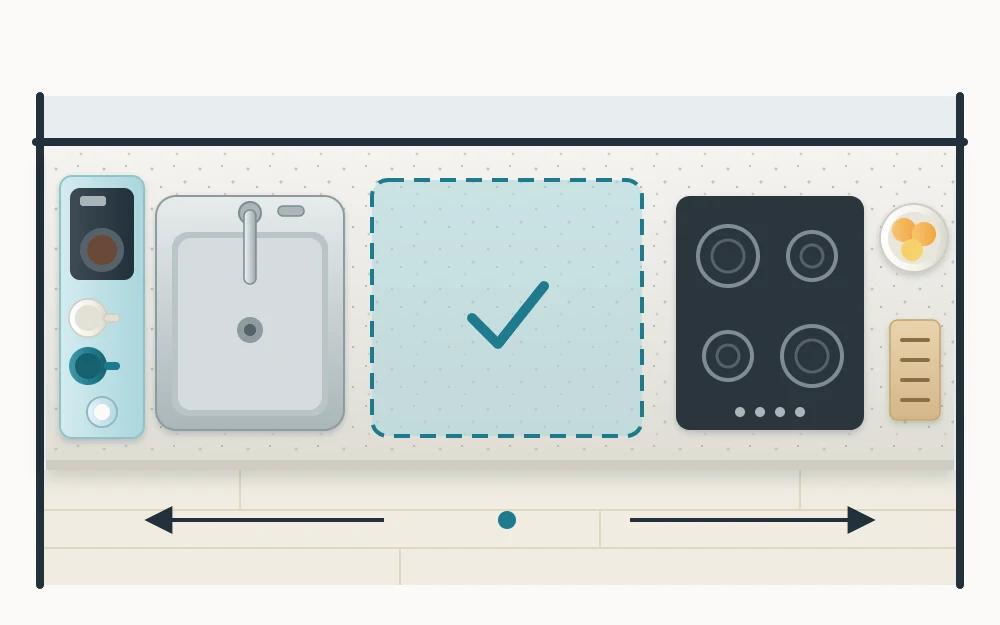
Find the longest uninterrupted run of counter, which in most layouts lies between the sink and the cooktop. This is your main prep stretch, and nothing lives on it. Not a canister, not a bowl, not a charging phone.
Push stations to the ends of the run and into corners, where the surface is harder to work on anyway. A clear middle is what makes the kitchen feel organized, far more than any container.
The counter around the sink has its own rules for soap, sponges and the drying rack. Those are covered in the guide to organizing the sink area.
Borrow a little space from the wall
A few items can come off the counter without going into a cabinet. A properly mounted magnetic strip can hold knives on the wall, a short rail with hooks can hold a few everyday tools, and hooks or a slim shelf under the upper cabinets can lift mugs off the surface.
Use this sparingly. A wall crowded with objects looks as cluttered as a counter. Follow each product’s fixing instructions and stated limit, and remember that the right fixing depends on your wall type.
Keep the area around the stove clear
The counter next to the cooktop is tempting storage because it is right where you cook. It is also where heat, flames and spatters are.
Keep the area beside and above the cooktop clear of anything that can burn or melt: dish towels, paper towels, plastic containers, potholders, curtains, and a crock of wooden utensils pushed right up to a burner. Place the utensil crock well to the side of the cooktop, where you can still reach it without leaning over a pan.
Good to know
For general guidance on keeping the cooking area clear, see the National Fire Protection Association’s cooking safety page. Follow each appliance manufacturer’s instructions for clearances, and keep cords and appliances away from the sink and from heat.
Give mail and keys a landing spot elsewhere
Paper and pocket contents arrive on the counter because it is the first flat surface inside the door. Telling people to stop rarely works; giving the items a better place does.
Set up a small landing spot outside the work area: a wall pocket for mail, a hook or dish for keys, a basket on a side table or at the far end of a counter nobody cooks on. Once that spot exists, moving stray items to it takes a few seconds in the evening, and the counter is ready for the next meal.
Frequently asked questions
What should be kept on kitchen counters?
As a starting point, only things that are used daily or nearly so, are awkward to move, and have a spot that does not block a work area. For many households that means a coffee maker, a utensil crock, a knife block and perhaps a fruit bowl. Everything else usually works better in a nearby cabinet.
How do I stop mail and keys from piling up on the counter?
Give them a landing spot that is easier to use than the counter, placed near the door and outside the cooking area. A wall pocket for mail and a hook or small dish for keys is often enough. Then move any strays there during a short evening reset.
Is it fine to keep a utensil crock next to the stove?
Keep it to the side of the cooktop rather than right at a burner, since wooden and plastic tools can burn or melt. The area beside and above the cooktop should stay clear of anything like that. Place the crock where you can reach it without leaning over a hot pan.