How to Organize Small Kitchen Appliances
Sort your small appliances by how often you use them, then give daily, weekly and occasional machines a matching home, with attachments, cords and manufacturer instructions accounted for.
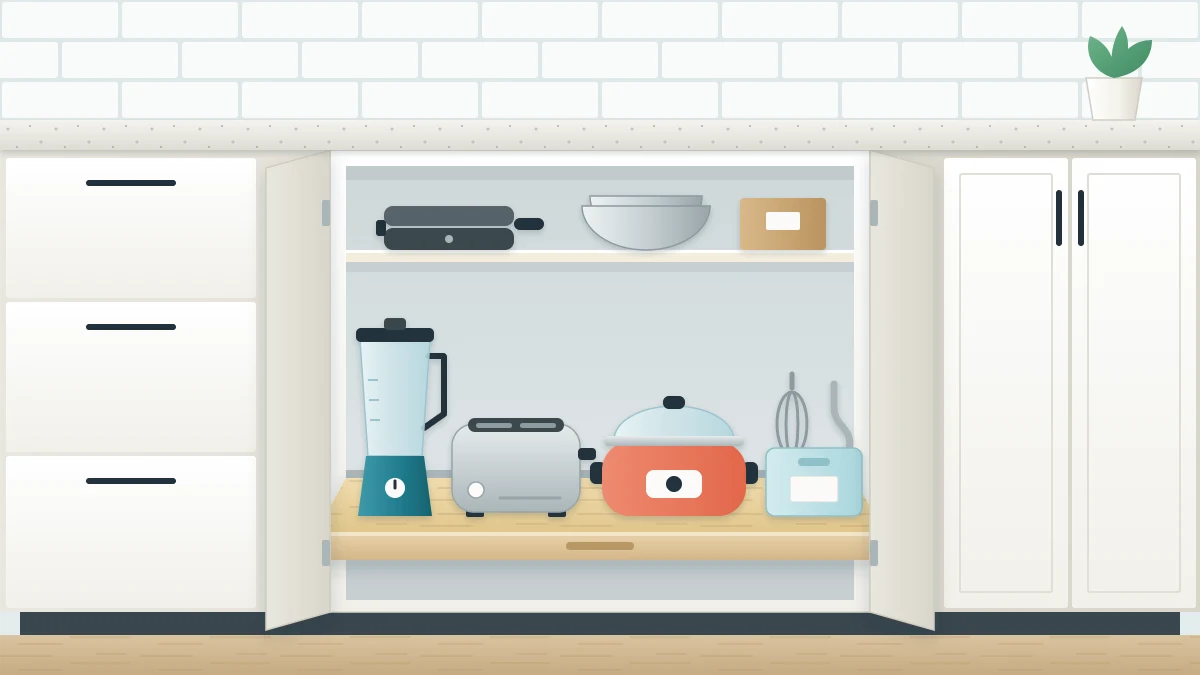
Small appliances are the bulkiest things most kitchens hold. A toaster, a blender, a stand mixer and a slow cooker can fill a whole run of counter between them, and the ones that do not fit there end up wedged into cabinets behind the pots.
The way to work out how to organize small kitchen appliances is to stop treating them as one group. Sort them by how often each one is used, then give each group a home that matches: the counter for daily use, easy-reach storage for weekly use, and the harder spots for the rest.
Sort by how often you use each one
Gather every appliance in one place, including those stored in other rooms. Then put each into one of three groups, being honest about the last few months rather than what you intend to do.
| Group | Typical examples | Where it lives |
|---|---|---|
| Daily | Coffee maker, kettle, toaster | On the counter, grouped in a station |
| Weekly | Blender, food processor, multicooker | Easy-reach lower cabinet or deep drawer |
| Occasional | Stand mixer, slow cooker, waffle iron | Higher or deeper shelves, or outside the kitchen |
The examples are only typical. A household that bakes every weekend may treat the stand mixer as a weekly item, and one that never makes toast can put the toaster away.
Daily appliances: a station on the counter
An appliance used every day may stay out, since lifting it in and out twice a day would be a nuisance. The aim is to keep the daily group small, usually two or three machines, and to stand them together rather than spread along the counter.
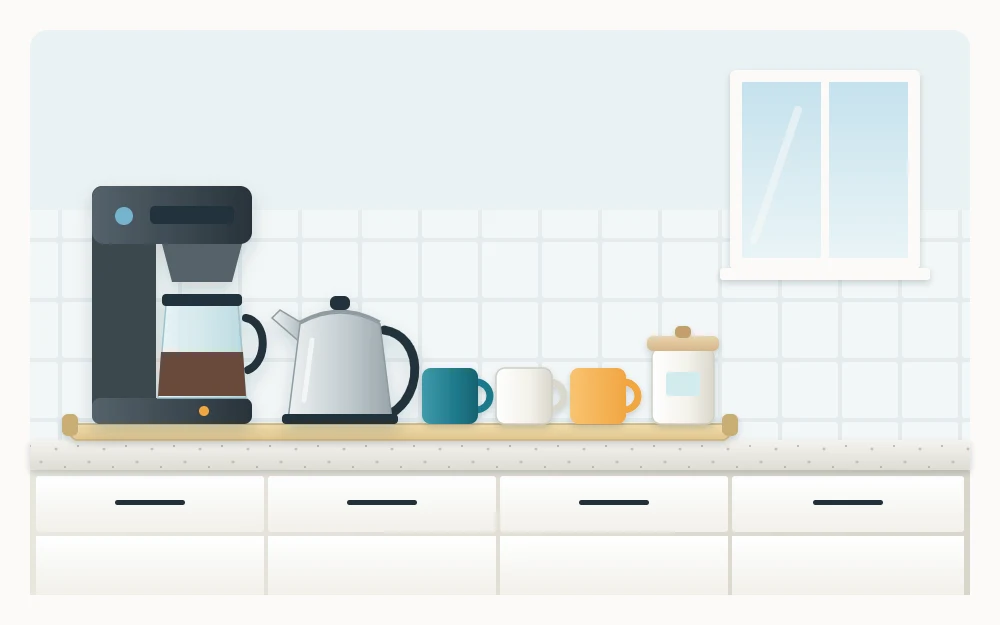
Group them into a station with their supplies. A coffee maker and kettle can share a tray with mugs and a canister of coffee or tea, close to the sink for filling. A tray also marks the edge of the station, so it does not creep outward.
Choose the spot by following each manufacturer’s instructions for clearances and ventilation, and keep appliances and their cords away from the sink basin and from the cooktop. How much of the counter to give up overall is covered in the guide to kitchen countertop organization.
Weekly appliances: easy reach, nothing in front
An appliance that comes out once or twice a week should take one move to fetch. That means a lower cabinet or deep drawer close to where it is used, with clear space in front of it.
The common mistake is to line appliances up two deep. The one at the back then needs the front one lifted out first, and it soon stops being used. Options that avoid this:
- A pull-out shelf that brings the whole row forward, where your cabinet allows one. Check the shelf’s stated limit against what you plan to keep on it.
- A deep drawer, where appliances are lifted straight up.
- A single row along the front of a shelf, with lighter things behind that are needed less.
Measure the height of each appliance with its lid or jug in place, and the inside height of the cabinet, before deciding. Blind corners are deep but awkward; if a corner is the only space you have, see the guide to corner cabinet organization before parking a machine in it.
Occasional appliances: higher, deeper or elsewhere
Machines used a few times a year do not need prime space. They can go on higher or deeper shelves, or leave the kitchen for a hall closet or utility shelf.
Weight decides which. A stand mixer or a slow cooker with a ceramic insert is heavy and awkward to lift, so keep it low, on a bottom shelf or the cabinet floor, rather than overhead. Lighter pieces such as a hand mixer or a waffle iron can go higher.
If cabinets are scarce, storing these outside the kitchen is often the better answer; the guide for a kitchen with little cabinet space looks at freestanding options.
Keep attachments with their appliance
Blades, beaters, discs, spare bowls and lids wander. Once a part is missing, the appliance is not much use.
Give each appliance one labeled bin for its attachments and keep that bin next to it, or inside its bowl if it fits. Sharp blades and cutting discs should sit in their own holder or with guards on, never loose in a drawer. Keep the instruction booklet in the same bin or in one folder for all appliances.
Cords
Coil each cord loosely and hold it with a soft tie or a hook-and-loop strip. Do not wrap a cord tightly around an appliance that is still warm, and avoid sharp bends where the cord meets the body. Some appliances have built-in cord storage; use it as the manufacturer describes.
If a cord or plug looks damaged, stop using the appliance and contact the manufacturer. For anything about outlets or wiring, such as too few outlets near a station, ask a qualified electrician.
Use and storage: the points that matter
Storage choices affect how an appliance is used, so a few points belong in any plan.
- Follow each appliance manufacturer’s instructions for clearances, ventilation and storage.
- Let appliances cool fully before putting them away.
- Unplug appliances that are stored, and unplug counter appliances as their instructions advise.
- Do not run heat-producing appliances such as toasters or air fryers inside a closed cabinet or under low cabinets unless the manufacturer says it is suitable.
- Keep appliances and cords away from water and from the cooktop.
Good to know
For general guidance on staying attentive in the cooking area, see the U.S. Fire Administration’s cooking fire safety page. Your appliance’s own manual is the reference for that particular machine.
Decide which appliances to let go
Sorting by frequency usually reveals a fourth group: appliances not used at all. A bread machine untouched for two years or a juicer that was a chore to wash takes space from things you do use.
Ask of each one whether you would buy it again today. If not, and it works, pass it on to someone who will use it. If two machines do the same job, keep the one you reach for.
Tip
Unsure about an appliance? Put a small piece of tape on it with today’s date written on. If the tape is still there untouched in six months, you have your answer.
Frequently asked questions
Which small appliances should stay on the counter?
Only the ones used every day, which for many households means a coffee maker, a kettle or a toaster. Keeping that group to two or three machines and standing them together as a station leaves the rest of the counter free for preparing meals.
Where should a heavy stand mixer be stored?
Low. A bottom shelf, the floor of a lower cabinet or a deep drawer near the baking area means you lift it a short distance rather than down from overhead. If a pull-out or lift shelf is involved, check its stated limit in the maker's documentation first.
Can a toaster be kept in a cabinet?
It can be stored in one once it has cooled fully and is unplugged. Using it there is a different matter: do not run a toaster or other heat-producing appliance inside a cabinet unless the manufacturer says it is suitable. Follow the manual for clearances.