How to Organize Kitchen Cleaning Supplies
Gather every cleaning product and tool, cut the duplicates, then split a small daily kit at the sink from the backstock stored elsewhere, with clear rules for storing products out of reach.
Cleaning products tend to spread. One bottle sits by the faucet, three more are under the sink, a spare pack of sponges is in a hall closet, and nobody is sure whether there is any dish soap left. Working out how to organize kitchen cleaning supplies is mostly a matter of bringing them back together and deciding what each one is for.
The method is the same one that works elsewhere in the kitchen: gather, reduce, split by how often you use things, then give each group a fixed home. The only extra step is a short set of storage rules, because these are products that need more care than a stack of bowls.
Gather everything in one place
Collect every cleaning product and tool that is used in the kitchen, wherever it currently lives: the sink edge, the cabinet below, the laundry area, the closet. Set it all out on the counter or the floor so you can see the whole collection at once.
Group as you go. Typical groups are dish washing, surface cleaners, floor products, cloths and sponges, brushes and scrubbers, trash bags, and gloves. Duplicates show up quickly once like sits with like.
Reduce before you store
Most households find several half-used bottles that do the same job, plus a few products bought for one task and never opened again. You do not need to organize what you will not use.
- Duplicates: choose one to use up first and put it at the front. Do not pour two part-used bottles together, even when they look alike.
- Products you never use: pass along unopened ones if someone wants them. For the rest, follow the disposal directions on the label and your local waste guidance rather than emptying them down the drain.
- Worn tools: let go of frayed brushes, cloths that have had their day and sponges that are falling apart.
- Unlabeled containers: if you cannot tell what is inside, do not keep it. Ask your local waste service how to dispose of it.
Split a daily kit from the backstock
What remains falls into two groups, and they should not share a home. The daily kit is the handful of things you reach for every day. The backstock is everything else: refills, spare packs and products for occasional jobs.
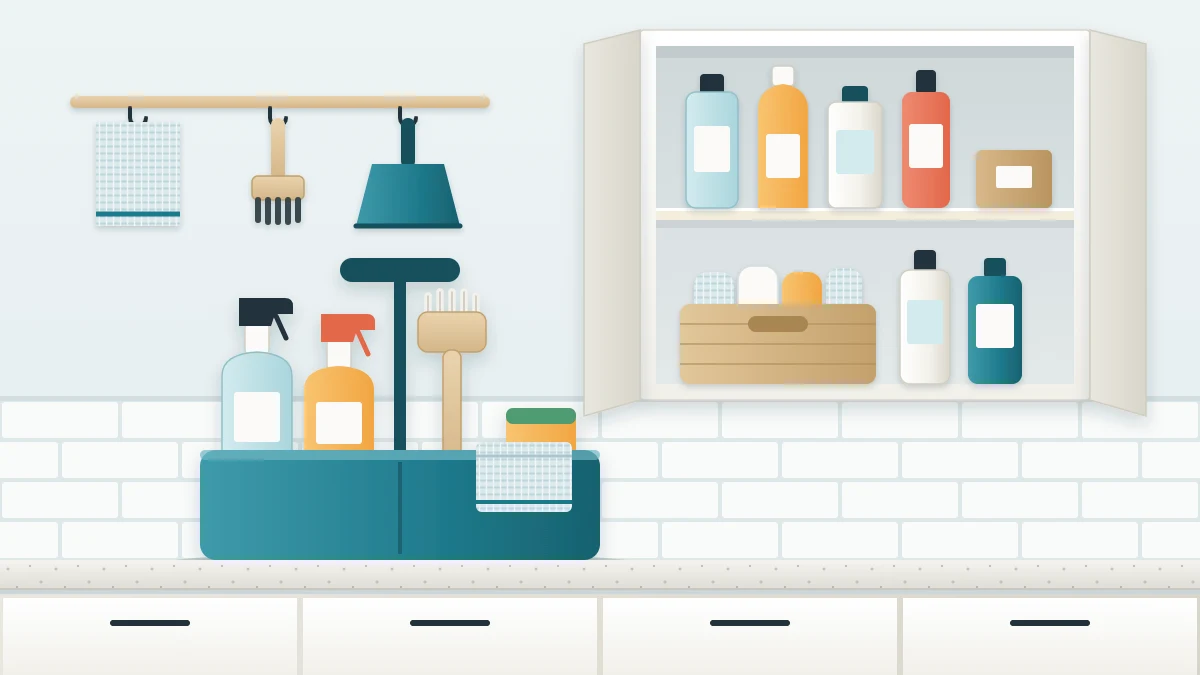
A daily kit is usually small: dish soap, one all-purpose cleaner, a couple of cloths, a brush and a sponge. It belongs within reach of the sink, in a caddy below or beside it. How much sits on the sink edge itself is a separate decision, covered in the guide to keeping the sink area tidy.
Choose a home for the main stock
There are three common places for the backstock and occasional products. None is right for every household; it depends on your cabinets and on who lives in the home.
| Location | Works well because | Watch for |
|---|---|---|
| Under the sink | Close to where products are used; nothing is stored with food | Low and easy for children and pets to reach, so it often needs a cabinet lock; pipes limit the space |
| High cabinet shelf | Out of reach of small children and pets | Harder for adults to reach too; keep it well apart from food and dishes and store bottles upright |
| Utility or hall closet | Room for bulky backstock and tall bottles | Farther from the kitchen; still needs a high shelf or a lock |
Many kitchens end up with a mix: the daily kit near the sink and the backstock in a closet. If the sink cabinet is your main spot, the under-sink organization guide covers working around the pipes and protecting the cabinet floor.
Contain by category and store upright
Loose bottles tip over and migrate to the back. A few plain containers fix that.
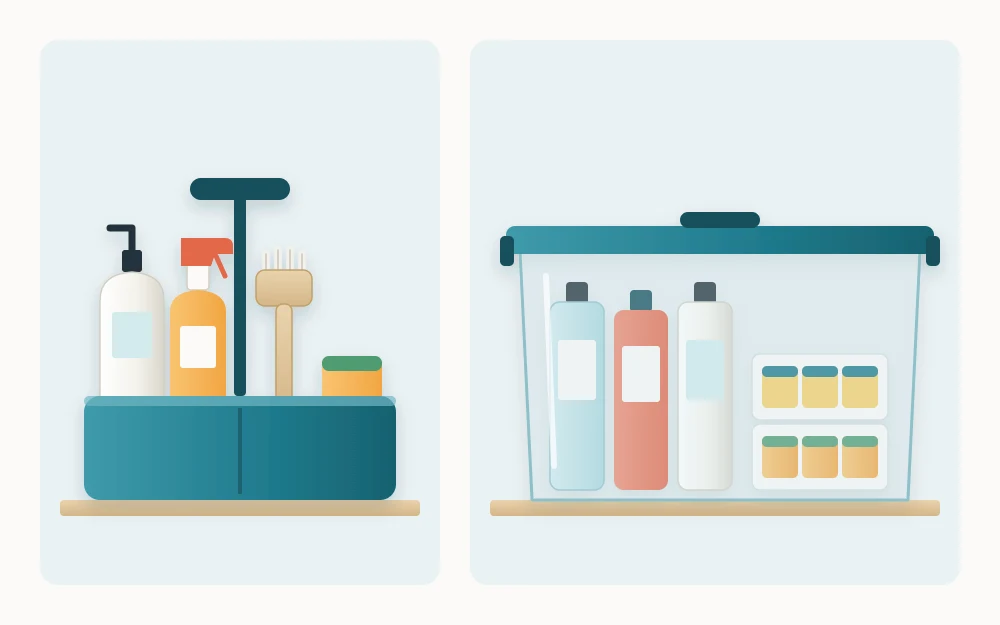
- A handled caddy for the daily kit, so the whole set lifts out in one move and can travel to another room.
- One bin per category for the rest: dish supplies, surface cleaners, floor products, spare cloths and sponges. Open bins with straight sides waste the least space.
- Upright storage for every bottle, with caps and triggers closed, so nothing leaks while lying on its side.
Measure the shelf or cabinet before buying bins, including the height under any pipe or shelf. As a rough example, a sink cabinet may offer only about 10 in (25 cm) of clear height in places, but yours may be quite different. A simple label on each bin, written by category, helps everyone in the household put things back.
Let tools dry instead of piling them up
Brushes, cloths and dustpans last longer and smell better when they can dry between uses. A damp heap at the bottom of a cabinet does neither.
Hang what can hang. Removable adhesive hooks or a small bar inside a cabinet door hold a brush, a dustpan and a pair of gloves; check the stated limit and surface instructions for whatever you use. Drape used cloths over a bar or the caddy edge until they are dry, then move them to the laundry. Keep clean spare cloths folded in their own bin so wet and dry never mix.
Storage rules that apply to every product
These points are short, and they matter more than any container.
- Keep every product in its original container with the label intact and readable.
- Follow each label for storage and for use.
- Never mix cleaning products, and do not combine leftovers into one bottle.
- Store products apart from food, dishes and anything used for eating or cooking.
- Keep them out of reach of children and pets: on a high shelf or behind a cabinet lock.
- Put products away right after use rather than leaving them on the counter.
Good to know
If someone may have swallowed a cleaning product or gotten it in their eyes or on their skin, contact Poison Control for guidance, or call emergency services if the person is in distress. Having the labeled container on hand makes it easier to say exactly what the product was.
Keep the system small
A cleaning shelf drifts when new bottles arrive before old ones are finished. Check the backstock bin before you shop, finish one product before opening the next, and return the caddy to its spot after each use.
A quick look once a season is usually enough to catch empties and stray items. Folding that check into a wider routine is covered in the guide on how to keep a kitchen organized.
Frequently asked questions
Where is the best place to store cleaning supplies in a kitchen?
It depends on your cabinets and who lives in the home. Under the sink is close to where products are used but low, so it often needs a cabinet lock. A high shelf or a utility closet keeps products out of reach of children and pets. Wherever you choose, keep products apart from food and dishes.
Can cleaning products be moved into matching bottles?
It is better not to. Keep each product in its original container with the label intact, because the label carries the directions for use, storage and disposal and tells you what the product is. If you want a uniform look, use matching bins or a caddy around the original bottles instead.
How many cleaning products does a kitchen need at the sink?
Usually only a handful: dish soap, one all-purpose cleaner, a couple of cloths, a brush and a sponge. Keep that daily kit in a small caddy near the sink and move refills, spare packs and occasional products to a separate backstock bin so the sink area stays easy to wipe.