Food Storage Container Organization: Ending the Lid Chaos
Purge the orphans, keep one or two sets that nest and share lids, then store containers in stacks and lids on edge in their own file so nothing tumbles out.
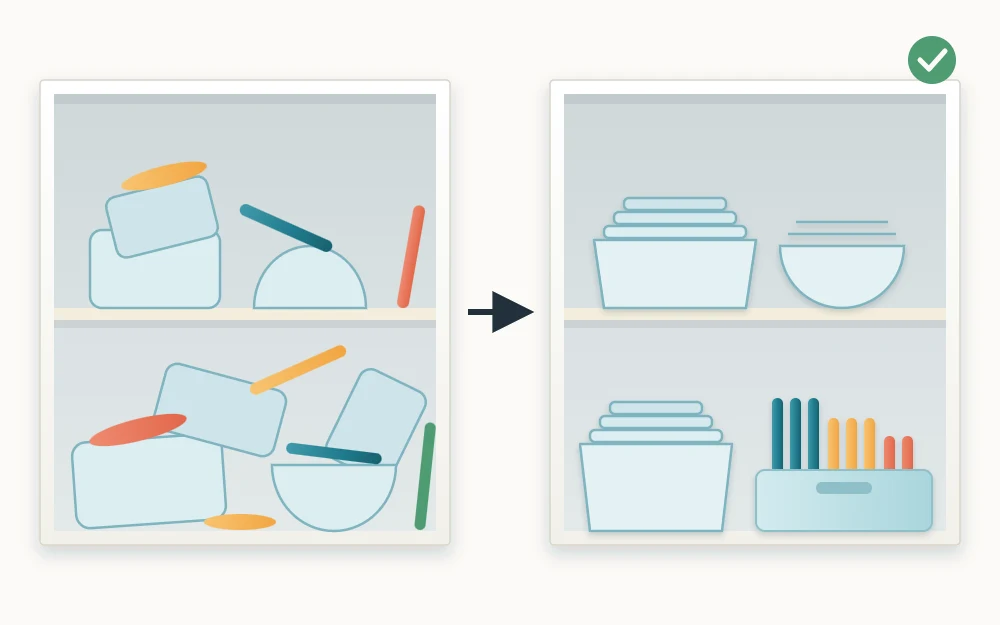
Open the container cabinet, and something slides out. A lid skitters across the floor, the stack you wanted is under three others, and the one container you can reach has no matching top. Food storage container organization fails for a simple reason: most collections are too large, too mixed and stored in one heap.
The fix comes in two parts. First reduce the collection to pieces that match and that you use. Then store containers and lids as two separate groups, so taking one piece out does not disturb the rest.
Start with a full purge
Take every container and every lid out of the cabinet, the drawer, the dish rack and anywhere else they hide, and spread them on the counter or table.
- Match each container to its lid and set the pairs together.
- Put containers without lids in one pile and lids without containers in another.
- Look over the matched pairs and pull out anything warped, cracked, badly stained or with a lid that no longer closes properly.
- Pull out the pieces you always skip: the odd shape, the one that is awkward to open, the tub saved from a takeout order.
Let the orphans and the damaged pieces go. A lidless container can sometimes earn a second job as a drawer organizer, but only if you have a specific drawer in mind today. Usable sets you do not need can be donated; check your local rules for which materials can be recycled. Containers are one of several categories that pile up quietly, and the checklist of what to get rid of in the kitchen lists the others.
Decide how many containers to keep
There is no correct number. A useful starting point is what a normal week asks for: the leftovers you typically store at one time, plus the lunches packed between dishwasher runs, plus a few spares. Lay that number out and see whether it looks right for your household.
Favor one or two sets whose pieces nest inside each other and share lid sizes. A dozen containers with three lid sizes are far easier to live with than a dozen containers with ten. If your collection is a patchwork of singles, keep the largest matching family and let the strays go, or replace gradually with one consistent set.
The space you choose in the next step sets the real limit. When the drawer or shelf is full, the collection is complete.
Pick the right spot
Containers belong near where leftovers are packed, which in most layouts is the counter between the stove and the refrigerator. Two kinds of space work well:
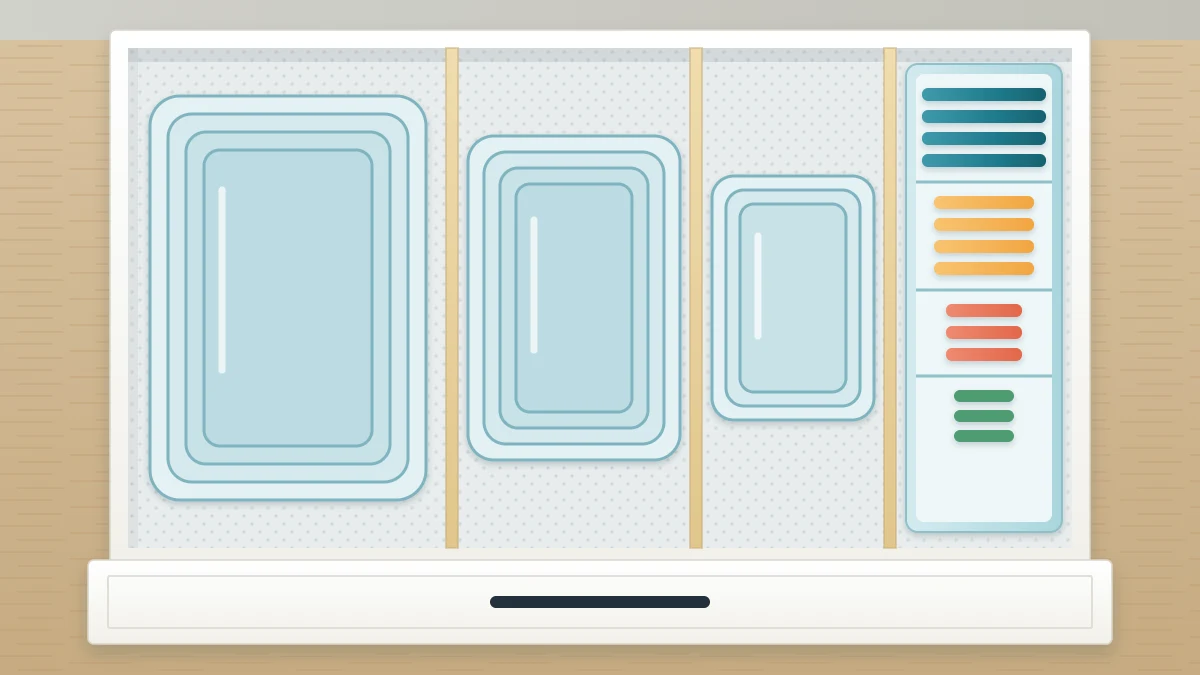
- A deep drawer. Everything is visible from above and nothing hides at the back, which makes this the easiest choice if you have one to spare. The guide to deep drawer organization covers dividers that keep stacks from sliding.
- A lower cabinet shelf. This works if the stacks sit in bins you can pull forward, so the back of the shelf stays reachable.
Upper cabinets are workable for light plastic pieces, but tall stacks above eye level are the classic source of the avalanche. Measure the inside height of the drawer or shelf before you plan stacks; a drawer that looks deep may give only about 8 in (20 cm) of usable height, depending on its construction.
Nest the containers, file the lids
This is the core of the system. Containers and lids are stored apart, each in the way that suits its shape.
Containers nest by shape and size: rounds inside rounds, rectangles inside rectangles, largest at the bottom. Keep each stack to one family so it stays stable, and keep stacks short enough to lift out with one hand.
Lids stand on edge, like files in a box, sorted by size. A narrow bin, a lid organizer with dividers or a divided section of the drawer all work. Standing upright, every lid is visible, and you can pull one without touching the others. Flat stacks of lids are what slide and scatter.
Cookware lids have the same problem at a larger scale and need their own answer; see the guide on how to organize pot lids.
Tip
Size the lid bin to your largest lid and measure it against the drawer height first. If the tallest lid cannot stand upright, lean the lids at an angle in a wider bin instead.
The alternative: lids on
You can also store each container closed, with its lid attached. Nothing ever needs matching, and grabbing one takes a second. The cost is space, since closed containers do not nest and each takes its full volume.
That trade makes sense for a small collection, such as the handful a one- or two-person household uses, or for a few glass pieces that are too heavy to nest comfortably. For a larger collection, nested stacks with a lid file hold much more in the same drawer.
Shapes and materials
| Type | Storage notes |
|---|---|
| Rectangular and square | Fill a drawer or shelf with little wasted space; line up neatly in rows |
| Round | Leave gaps between stacks; easiest to manage as one nested family |
| Plastic | Light, nests deeply, fine on higher shelves |
| Glass | Heavy and breakable; store low, in short stacks |
Keep glass in a drawer or on a lower cabinet shelf, where a slip has less distance to travel and you are not lifting a heavy stack down from overhead. Check the drawer’s or shelf’s stated limit if you plan to fill it with glass.
Which containers can go in a microwave, freezer, oven or dishwasher varies by product. Follow the manufacturer’s markings on each piece instead of assuming a whole set behaves the same way.
Keeping it going
A container drawer drifts back to chaos one small shortcut at a time. Three habits prevent most of it:
- Put pieces away dry. Damp containers stick together when nested, and it is tempting to toss them in loose instead.
- Return every lid to the file. Lids dropped on top of the stacks are the first step back to a heap.
- Retire strays at once. When a container cracks or a lid goes missing, the surviving partner goes straight to recycling or donation, not back in the drawer.
New containers follow the same logic: when a set comes in, an old one leaves. If takeout tubs arrive often, decide on a fixed small number to keep and recycle the rest where local rules allow.
Frequently asked questions
Is it better to store food containers with the lids on or off?
Lids off holds far more: containers nest inside each other and lids stand on edge in their own bin. Lids on means nothing ever needs matching, but every container takes its full volume. For a small collection, lids on is fine; for a larger one, nest the containers and file the lids.
How many food storage containers does a household need?
There is no fixed number. As a starting point, keep enough for a normal week of leftovers and packed lunches plus a few spares, then let the drawer or shelf you have chosen set the upper limit. One or two sets that nest and share lid sizes are easier to manage than many singles.
Where should glass food containers be stored?
Low, in a drawer or on a lower cabinet shelf, and in short stacks. Glass is heavy and breakable, so lifting a stack down from an upper cabinet is awkward. If you plan to fill a drawer or shelf with glass, check its stated limit first.