How to Organize Baking Supplies, Sheets and Pans
Stand sheets and racks on edge, nest pans by shape, gather the tools in one drawer or bin and give the mixer a low home. A calm setup for regular and occasional bakers alike.
Baking gear is awkward to store. Sheets and racks are wide and flat, tins are odd shapes, and the small tools scatter across three drawers. The usual result is a stack that clatters out of the cabinet whenever you need the piece at the bottom.
Working out how to organize baking supplies starts with one decision: how often you bake. That sets how much space the gear deserves. After that the method is simple: flat things stand on edge, round things nest, small things get a container, and everything lives close together.
Decide between a zone and a single cabinet
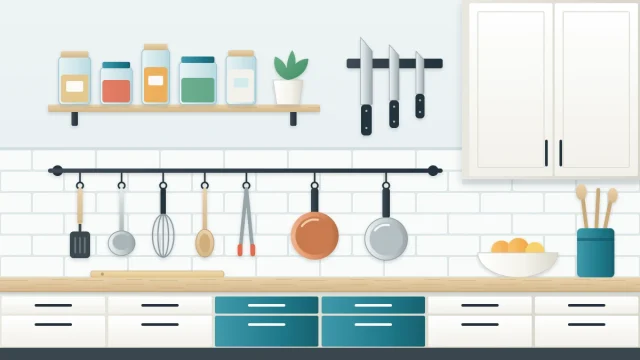
If you bake most weeks, treat baking as a zone of its own. Pick a stretch of counter with room to roll and mix, and give the cabinet and drawer nearest to it over to bakeware and tools, so a whole session happens within a step or two.
If you bake now and then, a zone would take prime space from things you use daily. One well-defined cabinet is enough, or a single shelf plus a lidded bin of tools that comes out when needed. A lower cabinet is usually the better choice, because bakeware is bulky and some of it is heavy.
Either way, gather everything first. Pull every sheet, pan, tin and tool from wherever it has ended up and look at it together. Duplicates, warped sheets and pans you never reach for are easier to let go of when you can see the whole collection.
Stand flat bakeware on edge
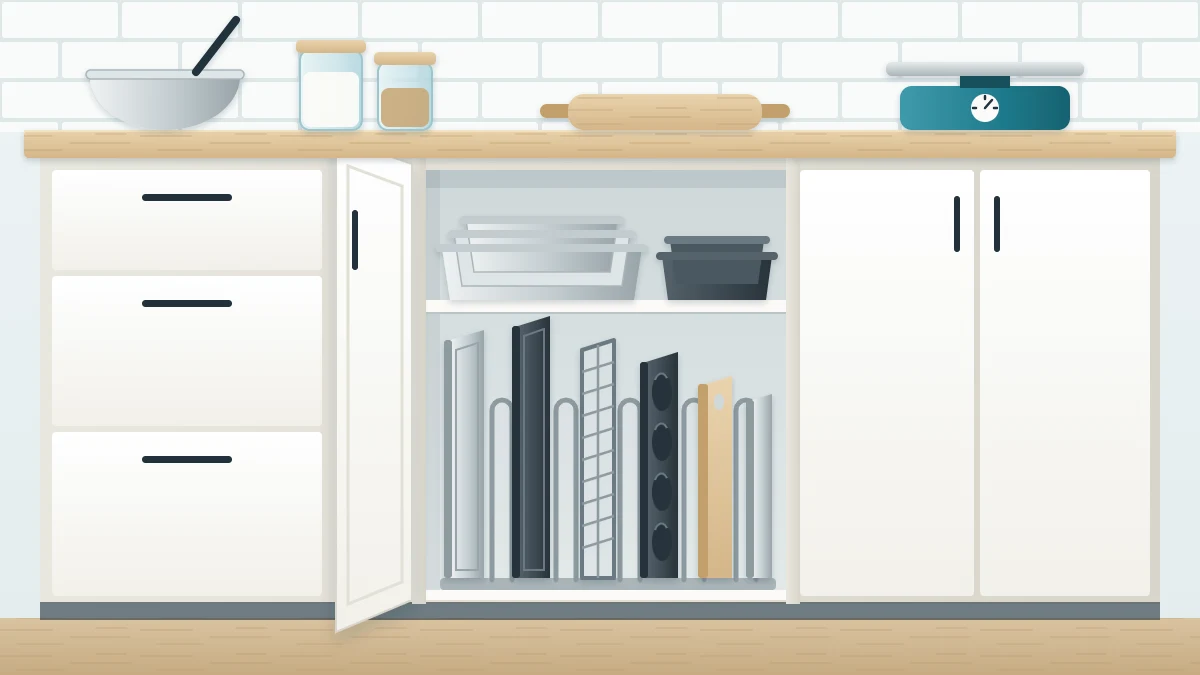
Baking sheets, cooling racks, muffin tins, pizza pans and cutting boards share one problem: stacked flat, the one you want is always underneath. Stored upright like files, each slides out alone.
There are three common ways to hold them on edge:
- An upright divider rack that sits on the cabinet shelf, with slots for several pieces.
- Tension rods fitted vertically between the cabinet floor and the shelf above, in pairs, to form slots of any width.
- A narrow cabinet, such as the slim one many kitchens have beside the range or at the end of a run, which keeps pieces upright by its width alone.
Measure your largest sheet before choosing a spot. It needs to fit the cabinet’s depth and clear the door frame, and the shelf opening must be taller than the sheet is wide when it stands on its long edge. Shelves in many cabinets can be moved or lifted out to make that height; the guide on organizing kitchen cabinets step by step covers adjusting shelves and measuring for organizers.
Sort the slots by size or use, with the two or three sheets you use most at the front.
Nest pans and bowls by size
Round and square cake pans, loaf pans, pie plates and mixing bowls nest well as long as you nest like with like. Put the same shape together, largest at the bottom, and keep each stack short enough that you can lift what sits on top with one hand.
A sheet of paper towel or a soft liner between coated pans protects the surface. Glass and ceramic dishes are heavy, so they go on a low shelf, not overhead.
Mixing bowls can share this space, or go in a deep drawer where you can see into them from above. The guide to organizing deep kitchen drawers shows how to keep nested sets from sliding.
Move rarely used shapes out of the way
A bundt pan, a springform pan and holiday cookie cutters see a handful of uses a year. They do not nest neatly and they do not need the best shelf. Put them higher, further back or in a labeled bin outside the kitchen, and bring them forward for the season they are used in.
Gather the tools in one place
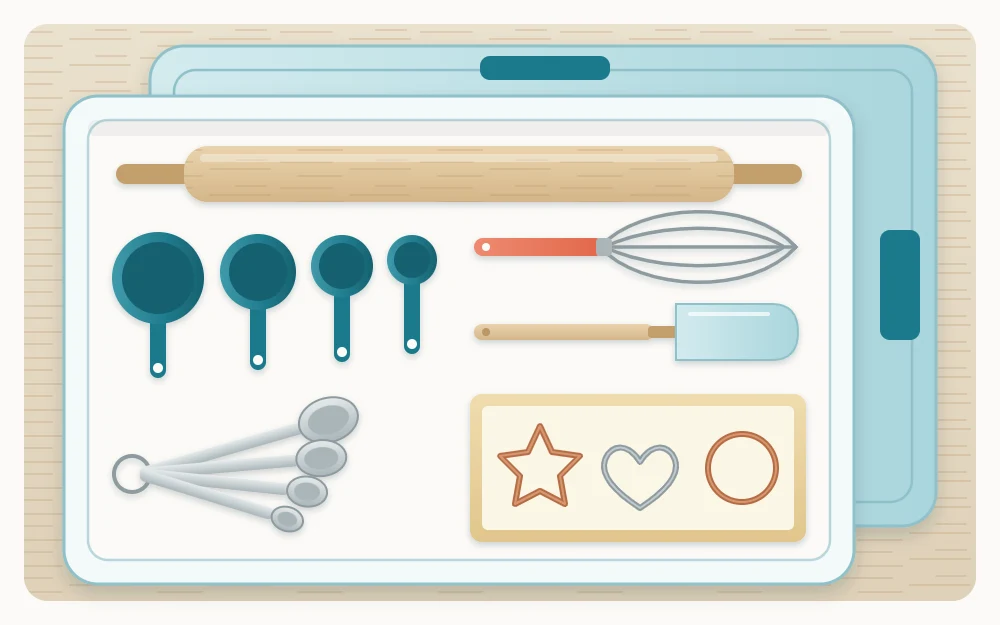
Baking tools get separated because many of them look like everyday utensils. Give them a single home: one drawer in the baking zone, or one lidded bin for an occasional baker. Typical contents are:
- Measuring cups and measuring spoons
- Spatulas and whisks kept for baking
- A rolling pin
- A pastry brush, bench scraper and sifter
- Piping tips, piping bags and cookie cutters
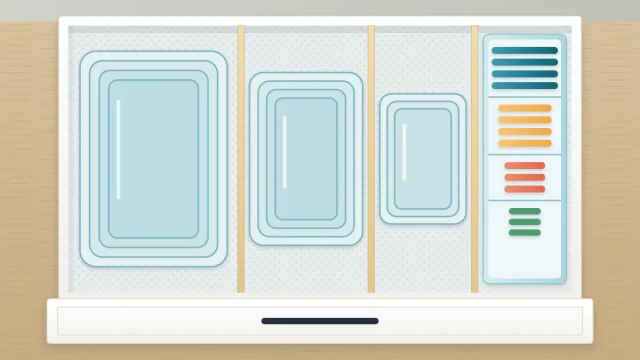
Small pieces need small containers inside the drawer or bin. A little lidded box for piping tips, a tin for cutters and a ring to hold measuring spoons together keep them from sinking to the bottom. Lay the rolling pin along one side so it does not roll over everything else.
Decorating bits and paper liners do better in a shallow bin of their own. Sprinkle jars, food coloring, candles and cupcake liners are light and easily crushed, so a shallow container keeps them in one layer where you can see them.
Tip
If several people bake in your home, a plain label on the tool bin and the decorating bin helps things come back to the right place. See the guide to labeling kitchen storage for wording and methods.
Keep baking staples together
Ingredients need only a brief note here. Keep the everyday baking staples, such as flour, sugar, leavening and vanilla, together on one shelf or in one handled bin near the baking zone, so they come out in one move.
Keep them in closed containers and follow the storage directions on each package. If you move something into another container, keep the package information with it.
Give the mixer a sensible home
A stand mixer is heavy and awkward to lift. If you use it weekly, a spot on the counter in the baking zone may be worth the space. If not, store it low, in a lower cabinet with clear space in front of it, never on a high shelf.
A hand mixer takes far less room. Keep it in the tool drawer or a small bin, with its beaters, and store the stand mixer’s attachments in a bin right beside the machine. Unplug mixers before storing them and coil cords loosely.
Check the drawer under the oven first
Many ranges have a drawer below the oven door, and it is a popular place for baking sheets. Before you put anything in it, look at the range manual. On some models it is a storage drawer; on others it is a warming drawer or a broiler, which heats up.
Good to know
Only use the oven drawer for storage if the range manufacturer’s manual says it is a storage drawer, and store only what the manual allows. If you cannot find the manual, look up the model number or leave the drawer empty.
Frequently asked questions
What is the best way to store baking sheets?
Stand them on edge like files, in an upright divider rack, between pairs of vertical tension rods or in a narrow cabinet. Each sheet then slides out alone instead of being pulled from under a stack. Measure your largest sheet first to be sure the cabinet depth and shelf height allow it.
Can I store pans in the drawer under the oven?
Check the range manual before you do. On some ranges that drawer is meant for storage, while on others it is a warming drawer or broiler that heats up. Use it only as the manufacturer describes, and leave it empty if you cannot confirm what it is.
Where should a stand mixer be stored?
If you use it every week, a counter spot in the baking area can be worth the space. Otherwise keep it low, in a lower cabinet with clear room in front so it lifts straight out. A heavy mixer should not go on a high shelf. Store its attachments in a bin beside it.