How to Organize a Kitchen With Little Cabinet Space
When the cabinets are full even after decluttering, storage has to come from somewhere else. These options use walls, freestanding furniture, appliance sides, doors and nearby rooms.
Some kitchens are short on cabinets no matter how well they are arranged. You have cleared out what you do not use, the shelves are sensibly filled, and there are still pots on the counter and plates with nowhere to go. At that point more tidying will not help. The room needs storage that is not a cabinet.
Organizing a kitchen with little cabinet space means looking at everything else the room offers: walls, floor, the sides of appliances, nearby doors and even the next room. The options below run roughly from the least cost and effort to the most, so you can stop as soon as the problem is solved.
Check that the cabinets are truly full
Before adding anything, make sure the cabinets you have are working hard. Tall gaps above short stacks, rarely used items in easy-reach spots and a shelf of things nobody uses all cost space you already own. A shelf riser or one more round of letting go is cheaper than a new piece of furniture.
If the cabinets are edited and still overflowing, move on. Write a list of what has no home, with rough sizes, because that list decides which of the following options is worth your money.
Put the walls to work
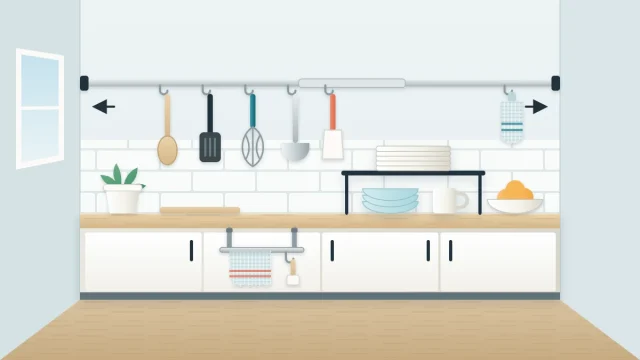
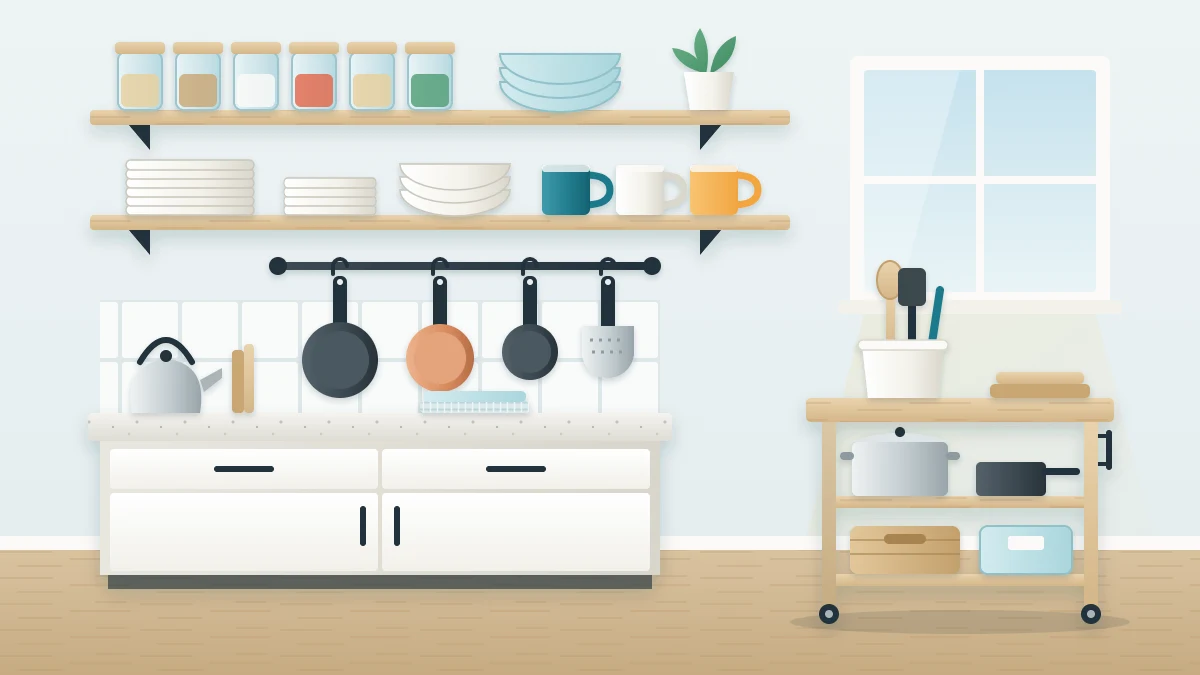
A bare wall is the largest unused storage surface in most kitchens. Three additions cover most needs:
- Rails with hooks for pans, utensils and mugs that have a hanging loop or handle.
- Open shelves for plates, bowls, glasses and jars that are used every day.
- A pegboard for a changing mix of tools, since the hooks can be moved as your needs change.
Keep wall storage to the side of the cooktop and never directly over the burners, and keep anything that can burn or melt away from the heat. The guide to using walls, doors and cabinet height covers placement in more detail.
Good to know
Every shelf, rail and rack has a limit stated by its maker, and stacks of dishes and cast iron are heavy. Follow that stated limit and the fixing instructions. The right anchor depends on the wall type; if you are unsure what is behind the wall, ask someone qualified.
Add freestanding furniture
Furniture brings cabinet-like storage without touching the walls. Which piece suits you depends on the floor space you have and what needs a home.
| Piece | Good for | Check first |
|---|---|---|
| Open shelving unit | Dishes, bins, small appliances | Depth, so it does not narrow a walkway |
| Sideboard or low cabinet | Serving pieces, linens, less-used cookware | Room for its doors to open fully |
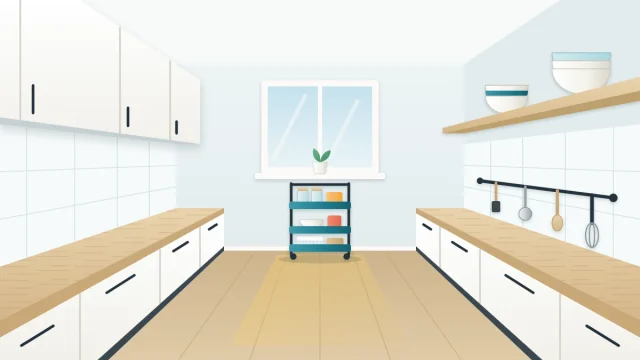
| Kitchen cart or small island | Extra work surface with shelves below | Clear floor on all sides you need to walk |
| Tall narrow cabinet | Slim gaps beside the fridge or at the end of a run | How it is secured against tipping |
Placement matters more than the piece itself. Before buying, mark the footprint on the floor with tape and live with it for a day or two. Open the oven door, the fridge door and the dishwasher fully, and walk your usual routes while carrying something. Furniture that blocks a door swing or pinches the main walkway will be a daily irritation, however much it holds.
Tall freestanding furniture should be secured against tipping, following the maker’s instructions. Load it with the heaviest items on the lowest shelves and the lightest at the top.
Use the sides of the fridge and end cabinets
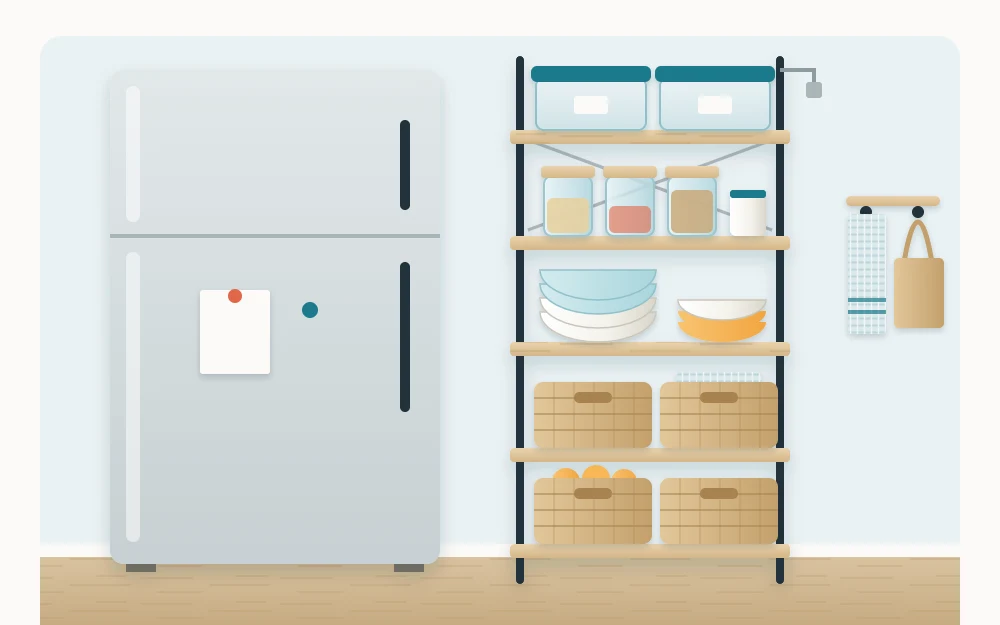
The exposed side of a refrigerator and the outer panel of an end cabinet are easy to overlook. A magnetic rack on a fridge side can hold light things such as paper towels, wraps or a few small jars. Hook-on racks that hang over the edge of a cabinet panel do a similar job for dish towels or cutting boards.
These are for light items only, used the way their instructions describe. Check that a rack does not block the fridge’s vents or stop its door from opening fully.
Borrow a nearby door
An over-door rack on a door close to the kitchen, such as a utility closet or basement door, adds several shallow shelves without any fixing. It suits light, flat or small things: wraps and bags, dish towels, lunch boxes, reusable shopping bags.
Hang it, load it and check that the door still closes and latches. Renters will find more ideas of this kind in the guide to organizing a rental kitchen without drilling.
Use the space above the upper cabinets
If there is a gap between your upper cabinets and the ceiling, it can hold light, rarely used things: a holiday platter, party supplies, spare food containers. Put them in lidded bins so they stay clean and come down in one trip.
Keep heavy items off this level entirely, and use a stable step stool rather than a chair to reach it. If something is needed more than a few times a year, it belongs lower.
Move overflow to another room
Not everything used in the kitchen has to be stored in it. A shelf in a hall closet, a laundry room or a garage can take backstock and occasional pieces, which frees the kitchen for daily use. Good candidates include:
- Bulk supplies such as paper towels and extra trash bags
- Occasional appliances like a slow cooker or waffle iron
- Large serving dishes and seasonal bakeware
Group these on one labeled shelf so they are easy to find, and follow the storage information on the package for any packaged food you keep there.
Edit what stays on show
Open shelves, rails and carts put your belongings on display, and they look calm only when they are edited. Choose what goes on show by three tests: it is used every day, it matches or sits well with its neighbors, and it gets washed often. Things on open storage gather dust and kitchen grease, so items in steady rotation stay cleaner than ones that sit for months.
That makes everyday plates, bowls, glasses and the pans you cook with weekly good candidates. Mismatched mugs, odd containers and rarely used gadgets are better behind a door or in a bin. Leave some empty space on each shelf, too; a shelf filled edge to edge reads as clutter even when it is tidy.
Finally, resist letting the counter become the overflow shelf. A clear work surface is worth more than one more stored item, and the guide to deciding what stays on the countertop can help you draw that line.
Frequently asked questions
Where do you put dishes when there are not enough cabinets?
Everyday plates, bowls and glasses do well on open wall shelves or a freestanding shelving unit, because they are washed often and stay clean in rotation. Keep the stacks short, follow the shelf maker's stated limit, and store special-occasion pieces in a sideboard or another room.
Is a kitchen cart worth it in a small kitchen?
It can be, if the floor allows it. Mark the cart's footprint with tape first and check that the oven, fridge and dishwasher doors still open fully and the walkway stays comfortable. A cart that passes that test adds both shelves and a little work surface.
What can be stored on top of kitchen cabinets?
Only light things that are rarely needed, such as a holiday platter, party supplies or spare containers, ideally inside lidded bins so they stay clean. Keep heavy items lower down, and use a stable step stool to reach the space rather than a chair.