Corner Cabinet Organization: Making Deep Corners Usable
Identify whether you have an L-shaped or a blind corner cabinet, then use placement, handled bins, turntables or a fitted pull-out so nothing disappears at the back.

Corner cabinets offer a lot of volume and very little access. Things pushed to the back are out of sight within a week, and getting them out again means kneeling on the floor and unloading everything in front. Corner cabinet organization is about working with that awkward shape so that whatever is stored there can come out without a struggle.
The right approach depends on which kind of corner you have, so start by identifying it. Then decide whether simple bins and careful placement are enough, or whether a turntable or a fitted pull-out is worth it.
The two common types of corner cabinet
The L-shaped corner cabinet sits diagonally across the corner or wraps around it, with a door on the corner itself. The door is often hinged in the middle (a bi-fold) so it folds out of the way and opens up both sides at once. You look straight into the corner, which makes this the easier type to use.
The blind corner cabinet is formed where one run of cabinets continues into the corner behind its neighbor. The door is offset to one side, and beyond the opening the cabinet carries on sideways into a space you cannot see directly. That hidden part is the “blind” section.
Both are hard for the same two reasons: depth, and a reach that has to go around a corner. The storage has to bring items to you.
Measure the opening, not just the inside
Before choosing any bin, turntable or fitting, take three sets of measurements:
- The door opening: width and height of the clear gap with the door fully open, allowing for hinges that stick into it.
- The interior: width, depth and height of each shelf space, including the blind section.
- Any obstructions: a center post, shelf supports, pipes or the edge of the neighboring cabinet.
The opening is the measurement people most often skip. A bin that fits the interior is of no use if it cannot pass through the door, and blind corner openings are often narrow; one might be only about 12 in (30 cm) wide, though yours may differ.
Organizing a corner without any fittings
You can make a corner cabinet workable with placement alone. The rule is simple: the opening is prime space, and the back is long-term storage.
- At the opening: things you use weekly, each one reachable without moving anything else.
- At the back: large, light or seldom-used single items, such as a roasting pan, a big salad bowl, a seasonal platter or a cooler bag. One big item is easy to find and easy to drag forward; twenty small ones are not.
- Never at the back: small loose things, or anything stacked several deep.
Bins with handles turn a blind section into something closer to a drawer. Group related items in one bin, slide it into the hidden space, and pull the whole bin out through the opening when you need something from it.
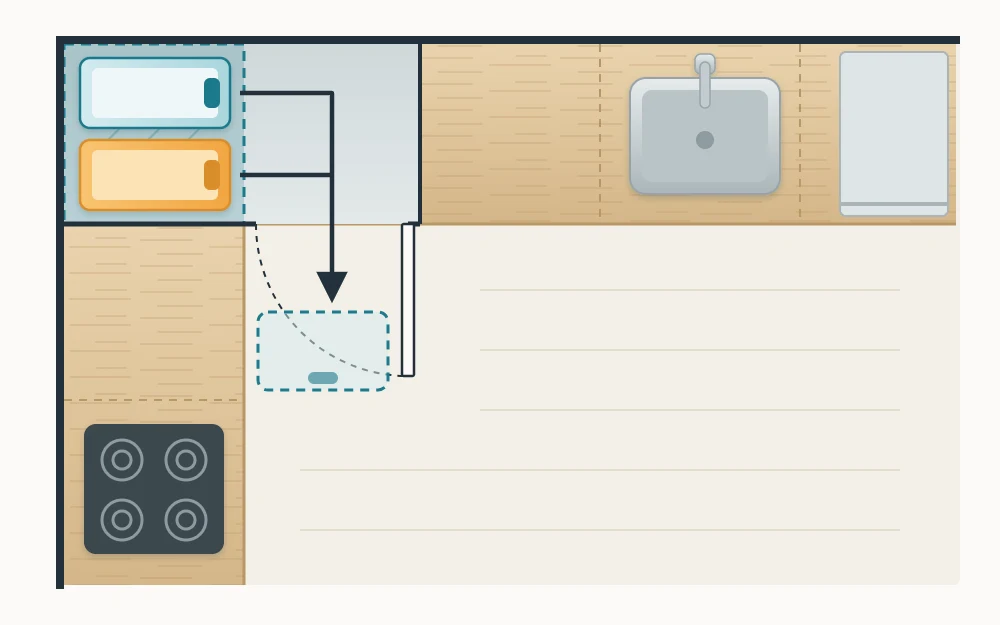
Keep those bins light enough to slide with one hand. Heavy contents make them hard to move and hard on the shelf, so cast iron and stacks of plates are better stored elsewhere.
Turntables and rotating shelves
A turntable, often called a lazy Susan, solves the reach problem by rotating the back of the shelf to the front. There are two kinds.
Built-in rotating shelves come with many L-shaped corner cabinets: two round or pie-cut shelves on a center post or on pivots. If you have them, the task is to load them well. Put items near the outer edge where you can see them, keep things from overhanging the rim so they do not catch on the cabinet walls as it turns, and avoid tall stacks that topple when the shelf spins.
Free-standing turntables sit on a fixed shelf. Size one to the shelf depth and check that it can make a full turn with the door closed.
Rotating shelves suit pots, mixing bowls, colanders and compact small appliances. If the corner is where your cookware lives, the guide on how to organize pots and pans covers nesting and what to do with the lids.
Good to know
Rotating shelves and turntables have a stated limit set by the maker. Cookware and stacked dishes are heavy, so check that limit before loading a shelf, and spread the load evenly around the center.
Pull-out and swing-out systems for blind corners
For blind corners there are fitted mechanisms that bring the hidden shelves out through the opening. Some slide forward and then sideways so the back section follows the front one out. Others are shaped shelves that swing out on an arm attached to the door or the cabinet side.
They can make a blind corner far more usable, with three caveats. Each system is built for a specific range of cabinet widths, opening sizes and door hinge sides, so it must match your measurements exactly. The frame takes up room, so you gain access but lose some volume. And fitting one means following the maker’s installation instructions, including how it is fixed to the cabinet; if that is beyond what you are comfortable doing, ask someone qualified.
Upper corner cabinets
Upper corners have the same shape problem at a smaller scale, and their contents should be lighter. A free-standing turntable on each shelf works well for mugs, glasses, or small bowls. A tiered shelf riser set into the back corner lifts the rear rows so you can see what is there.
The general rules for shelf heights and prime space are in the guide on how to organize kitchen cabinets.
What to store in a corner cabinet
Corners suit bulky items that are used now and then rather than daily:
- Large pots, stockpots and roasting pans
- Mixing bowls, colanders and salad spinners
- Small appliances used weekly or monthly
- Serving pieces and seasonal items
Appliances are a good match for a lower corner because they are bulky single items, as long as you can lift them out comfortably. Let them cool, unplug them and wrap the cord loosely before they go in; the guide on how to organize small appliances explains how to decide which ones deserve easier spots.
What does not belong in a corner is anything small, anything you use every day and anything you would forget you own. If the cabinet still swallows things after all this, store less in it.
Frequently asked questions
What is the difference between a blind corner and an L-shaped corner cabinet?
An L-shaped corner cabinet has its door on the corner itself, often a bi-fold, so you look straight in. A blind corner is formed where one cabinet run continues behind its neighbor: the door is offset to one side and part of the interior is hidden sideways beyond the opening.
What should be stored in a corner kitchen cabinet?
Bulky items used now and then suit a corner best: large pots, roasting pans, mixing bowls, colanders, serving pieces and small appliances used weekly or monthly. Avoid small loose items and anything needed every day, because they are the things that get lost at the back.
Can a blind corner cabinet be organized without installing a pull-out?
Yes. Keep frequently used items at the opening and use bins with handles in the hidden section, so each bin slides out as a unit like a drawer. Store large single items at the very back. Measure the door opening first, since every bin has to pass through it.