Common Kitchen Organization Mistakes and How to Fix Them
Ten frequent kitchen organization mistakes, from buying bins too early to overfilled shelves, each with the reason it causes trouble and a simple fix.
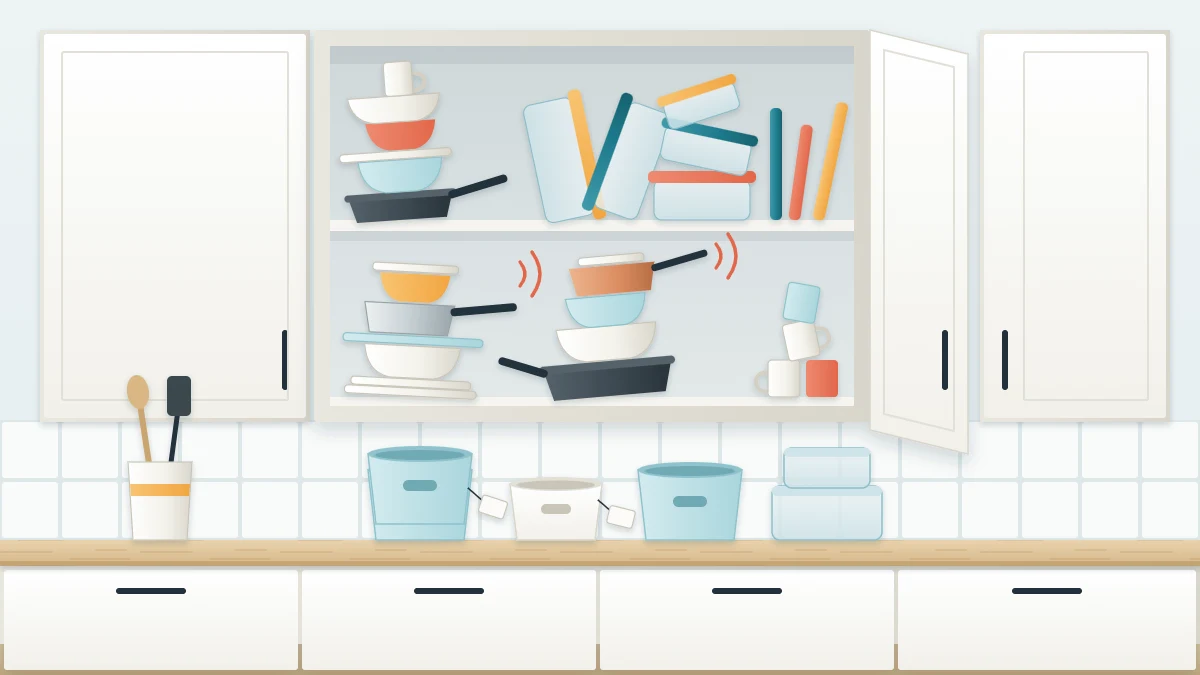
You cleared a weekend, bought some bins, rearranged the cabinets, and a month later the kitchen is no easier to use than before. That outcome is common, and it says very little about your effort or ability.
Most kitchen organization mistakes are sensible ideas applied at the wrong moment or pushed a bit too far. Below are ten of the most frequent, grouped by cause, each with the reason it creates trouble and a plain fix. Find the two or three that sound familiar and start there.
Mistakes in the order of work
1. Buying organizers before decluttering and measuring
Why it causes trouble: You end up choosing containers for things you may not keep, in sizes guessed from memory. Bins that do not fit get left on the counter, and the ones that do fit often hold clutter.
The fix: Reduce first, using a step-by-step plan to declutter the kitchen. Then measure the inside of the exact shelf or drawer, allowing for hinges and frames, and compare with the product’s listed dimensions. Buy only for a specific problem in a specific spot.
2. Keeping duplicates “just in case”
Why it causes trouble: Five spatulas and four sets of measuring cups take the space of one of each several times over, and the favorite still gets used every time.
The fix: Lay duplicates side by side and keep the number you use between washes. If letting go feels risky, box the extras with a date and see whether you ever go looking for them.
Mistakes in where things go
3. Organizing by what looks good instead of where things are used
Why it causes trouble: Matching sets displayed together look tidy, but if the mugs end up across the room from the coffee maker, you pay for it in steps every morning.
The fix: Store each group beside the task it serves. Planning kitchen zones by activity gives you a layout to follow. Appearance can come second, once function is settled.
4. Letting the counter become storage
Why it causes trouble: The countertop is the work surface. Every appliance, canister and stack that lives on it shrinks the room you have to prepare food, and a crowded counter attracts more things.
The fix: Keep out only what is used daily. Everything else gets a home in a cabinet or drawer. Keep the area around the cooktop clear, and let appliances cool and unplug them before putting them away.
Mistakes inside cabinets and drawers
5. Filling every shelf to the limit
Why it causes trouble: A shelf packed edge to edge has no slack. Taking one thing out disturbs its neighbors, and putting it back means fitting a puzzle together. People stop bothering.
The fix: Aim to leave some of each shelf and drawer empty, as a rough guide around a fifth. If a space cannot spare that, it is holding too much, and the answer is fewer items, not tighter packing.
6. Stacking unlike items so the bottom one is trapped
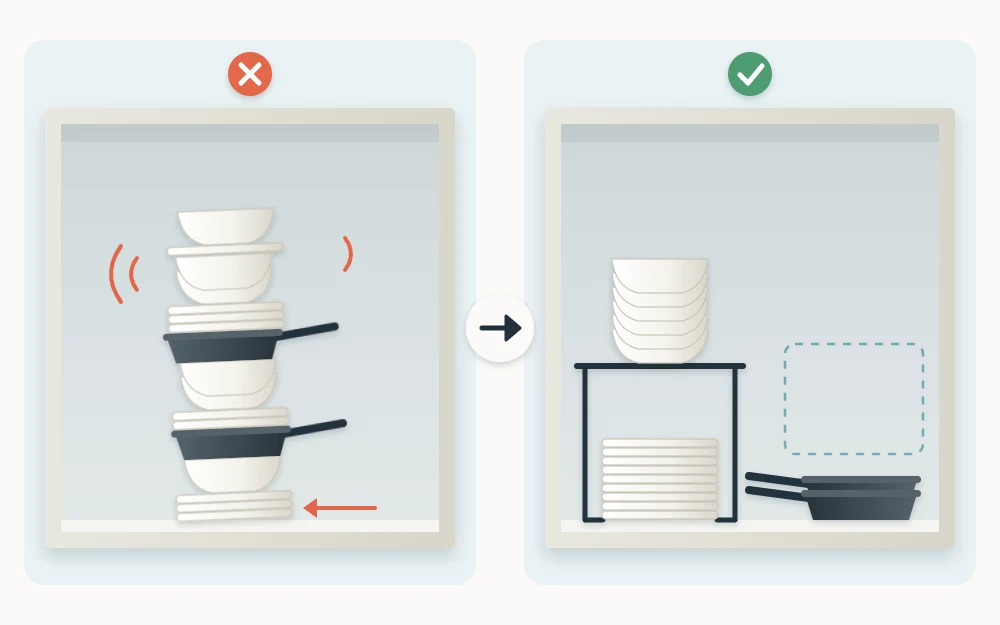
Why it causes trouble: A mixed tower of plates, bowls and a skillet means lifting three things to reach the fourth. Stacks like this are also unstable, and dishes and cast iron are heavy.
The fix: Stack only like with like, and keep stacks short enough to lift with one hand. Give each kind of item its own stack or its own level.
7. Ignoring vertical space inside cabinets
Why it causes trouble: Many cabinets have widely spaced shelves, so a short stack of bowls sits under a large gap of unused air. That wasted height is what tempts you to build tall mixed stacks.
The fix: Move adjustable shelves where the cabinet allows it, or add a shelf riser or an under-shelf basket that you have measured for. The guide to vertical kitchen storage goes through the options.
Good to know
Risers, baskets and shelves all have limits. Check the product’s and the cabinet maker’s stated limit before loading them with dishes, and keep the heaviest items on the lower levels.
Mistakes that make a system hard to live with
8. Decanting or labeling everything
Why it causes trouble: Transferring every product into a matching container and labeling every shelf creates upkeep. Each refill becomes a chore, and when the upkeep lapses the system looks worse than no system.
The fix: Use containers and labels selectively, where they solve a real problem: a bin whose contents are not visible, or a spot other people keep getting wrong. Leave the rest as it is.
9. Systems too fiddly for the rest of the household
Why it causes trouble: Lidded boxes, exact slots and items nested in a set order ask for more care than most people give at the end of a meal. One skipped step and the arrangement unravels.
The fix: Design for the least patient person in the house. Open bins, generous spaces and one-motion homes get used. If a spot keeps failing, simplify it.
The mistake of never revisiting the setup
10. Treating organizing as finished
Why it causes trouble: Households change. New equipment arrives, routines shift, children grow. An arrangement that fit two years ago slowly stops fitting, and the mismatch shows up as clutter.
The fix: Build in small check-ups: a short daily reset and an occasional review of one area at a time. The guide on how to keep a kitchen organized sets out a workable rhythm.
Which mistake to fix first
If several of these apply, the order matters more than the speed. This quick reference matches the symptom to a starting point.
| What you notice | Likely mistake | Start with |
|---|---|---|
| Cabinets and drawers are simply too full | 1, 2 or 5 | Decluttering |
| You walk back and forth for basics | 3 | Zones |
| No room to prepare food | 4 | Clearing the counter |
| Things topple or get buried | 6 or 7 | Shorter stacks and added levels |
| Nobody else follows the system | 8 or 9 | Simplifying |
Work on one mistake at a time and live with the change for a week or two before making the next. Small corrections that stick do more for a kitchen than another full overhaul.
Frequently asked questions
What is the most common kitchen organization mistake?
Buying organizers before decluttering and measuring is among the most frequent. Containers bought early are sized by guesswork and often end up holding things that should have left the kitchen. Reducing what you own first, then measuring the exact space, means any organizer you buy answers a real need.
Why do kitchen cabinets get messy again so fast?
Often because the shelves are too full or the stacks are mixed. When there is no spare room, taking one item out disturbs the rest and putting it back is awkward, so things get left out or shoved in. Fewer items, short stacks of like things and some empty space make returning items easy.
Do I need to label and decant everything for an organized kitchen?
No. Labels and matching containers add upkeep, so they are worth using only where they solve a specific problem, such as an opaque bin or a spot that other people keep getting wrong. A kitchen can be well organized with very few labels if items are stored where they are used.


