Kitchen Zones: How to Organize a Kitchen by Activity
What kitchen zones are, what typically lives in each one, and a simple way to map them onto your own layout, including compromises for small or awkward kitchens.
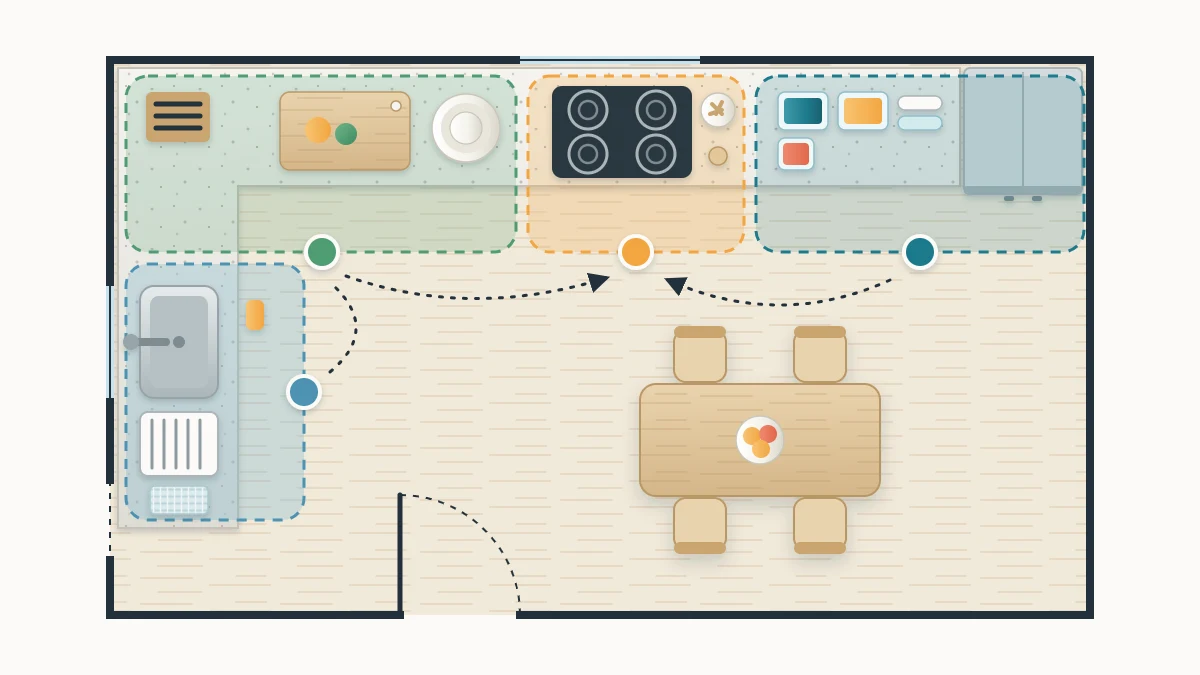
Once the excess is gone, a new question takes its place: where should everything go? Putting things back wherever there is a gap works for a week, then the walking back and forth starts again.
Kitchen zones answer that question. A zone is a part of the kitchen set up for one activity, with the things that activity needs stored right there. You stop asking “where is there room?” and start asking “where do I use this?”
What a zone is
A zone has two parts: a place where a task happens and the storage within arm’s reach of it. Chopping happens on a stretch of counter, so the knives and cutting boards live beside that stretch. Washing up happens at the sink, so dish soap and dish towels live around the sink.
The payoff is fewer steps and fewer decisions. When an item is stored where it is used, getting it out is one motion and putting it back is obvious, including for the other people who use the room.
Zones are not rooms within a room. In most kitchens they overlap, and a single cabinet often serves two of them. That is fine.
The common zones and what lives in each
Most home kitchens have some version of the zones below. Treat the list as a starting point and drop or merge any that do not match how your household cooks.
| Zone | Where | What lives there |
|---|---|---|
| Prep | The longest clear stretch of counter | Knives, cutting boards, mixing bowls, measuring tools |
| Cooking | Beside the stove | Pots, pans, cooking utensils, oils and everyday seasonings |
| Cleaning | Around the sink | Dish soap, dish towels, trash and recycling, dishwasher supplies |
| Everyday dishes | Near the dishwasher or drying rack, and the table | Plates, bowls, glasses, mugs, flatware |
| Food storage | Near the refrigerator or prep counter | Food containers and lids, wraps, bags |
| Coffee or breakfast | A corner of counter with a cabinet nearby | Coffee maker or kettle, mugs, filters, cereal bowls |
| Baking (optional) | A lower cabinet or deep drawer | Baking sheets, pans, rolling pin, mixer attachments |
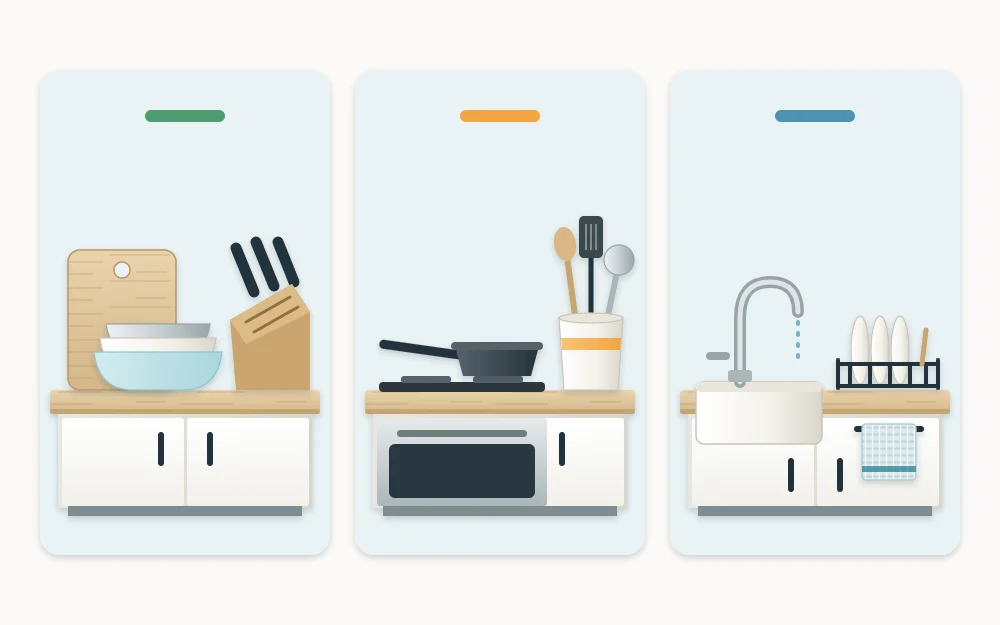
Notes on the main zones
Prep. This zone usually does the most work, so it gets the best counter. Keep knives in a block, on a properly mounted magnetic strip or in an in-drawer holder, never loose in a drawer.
Cooking. Pots and pans go in the lower cabinets or drawers nearest the stove, where their weight is easy to handle. Keep oils, seasonings and the utensil crock to the side of the cooktop, close enough to reach but away from the burners. Leave the area directly around the heat clear.
Cleaning. Follow each product’s label for storage, keep cleaning products in their original containers and out of reach of children and pets, and store them apart from food and dishes.
Everyday dishes. The best spot is wherever unloading takes the fewest steps. If that conflicts with being near the table, favor the dishwasher or drying rack; you put dishes away more often than you set a table.
Food ingredients. Dry goods and packaged food get a shelf or cabinet of their own, ideally near the prep counter, so they are not scattered among dishes.
How to map zones onto your own layout
No floor plan transfers neatly from one kitchen to another. The reliable way to find your zones is to act out the tasks.
- Stand where you do each task. Where do you actually chop? Where do you make coffee? Use the real spot, not the one you think you should use.
- Note what you reach for. Walk through a typical meal in your head, or pay attention during the next one, and list every item you pick up at that spot.
- Look at the storage within one step. The drawers and cabinets you can reach without moving your feet much are that zone’s storage.
- Assign groups to that storage. The items on your list move in. Items stored there that belong to a different task move out.
- Place the leftovers. Things used rarely, or used all over the kitchen, go in whatever space remains.
Within each zone, the items used most often get the easiest spots. The guide on where to store frequently used kitchen items covers how to rank things by use, and the guide to organizing kitchen cabinets covers arranging the shelves once you know what goes in them.
Tip
Before moving anything, mark each cabinet and drawer with a removable sticky note naming its planned zone. Reading the whole room at once makes gaps and overlaps easy to spot.
Compromises in small or awkward kitchens
A compact kitchen may have one stretch of counter and four cabinets. Zones still apply; they just share.
- Share a cabinet. One shelf for everyday dishes, one for food containers. A zone can be a single shelf or half a drawer.
- Let prep and cooking merge. When the only counter is beside the stove, treat them as one zone and store both sets of tools there.
- Move a zone out of the kitchen. A baking kit or a coffee setup can live on a nearby shelf or cart if the kitchen has no room for it.
- Protect the counter. In a small kitchen the work surface is the scarcest thing you have. Deciding what earns a place on it is covered in the guide to kitchen countertop organization.
Awkward features need the same flexibility. If the dishwasher is far from every upper cabinet, a lower drawer for plates may serve better than the traditional shelf.
Treat the first layout as a draft
Your first arrangement is an informed guess. Use it for a couple of weeks and watch for the signs that something is in the wrong place: you keep crossing the room for the same item, things pile up on the counter instead of going back, or other people keep asking where something is.
Each of those is a prompt to move one group, not to start over. Small corrections after real use are how a layout ends up fitting the household.
Zones are the third step of a longer sequence. If you have not yet cleared out what you do not use, or you want to see how the steps fit together, the overview of kitchen organization for beginners lays out the full order.
Frequently asked questions
What are the main zones in a kitchen?
Most home kitchens have a prep zone on the main stretch of counter, a cooking zone beside the stove, a cleaning zone around the sink, a spot for everyday dishes near the dishwasher or drying rack, and a food storage zone for containers and wraps. Coffee and baking zones are optional extras.
Can kitchen zones work in a very small kitchen?
Yes. In a small kitchen a zone may be one shelf or half a drawer, and two zones often share a cabinet. Prep and cooking commonly merge when there is only one counter. The principle stays the same: store each group of items as close as you can to where it is used.
How do I know if the zones are working?
Use the layout for a couple of weeks and notice the friction. Crossing the room repeatedly for one item, things left on the counter instead of returned, or family members asking where something is all point to a group stored in the wrong place. Move that group and test again.


