Rental Kitchen Organization: Ideas That Need No Drilling
A no-drill toolkit for renters: tension rods, removable adhesive hooks, over-door and magnetic racks, freestanding organizers and furniture, with what each suits and what to check first.

Renting usually means living with the kitchen as it is: fixed shelves, too few drawers, and a lease that says no holes in the walls or cabinets. That rules out a lot of common storage advice, but it leaves more options than it first seems.
Rental kitchen organization relies on things that grip, hang, stand or stick lightly rather than things that screw in. None of it marks the room when used as directed, and all of it can leave with you. The sections below go through the no-drill toolkit, what each piece suits and what to check before relying on it.
Read the lease before you start
Leases differ. Some forbid any fixing at all; others allow a few small holes if they are filled when you leave, and many landlords will agree to a rail or a shelf if you ask. Read the wording, and if it is unclear, ask in writing and keep the answer.
If the answer is no, or you would rather not ask, everything below works without tools.
Tension rods
A tension rod presses outward between two facing surfaces and stays in place by friction. In a kitchen it has several uses:
- Fitted vertically or front to back inside a cabinet, a pair of short rods makes slots that hold baking sheets, trays and cutting boards on edge.
- Across the front of a deep drawer, a rod keeps lids standing against the drawer front.
- Under the sink, a rod can hold spray bottles by their triggers, if the rod is rated for that use.
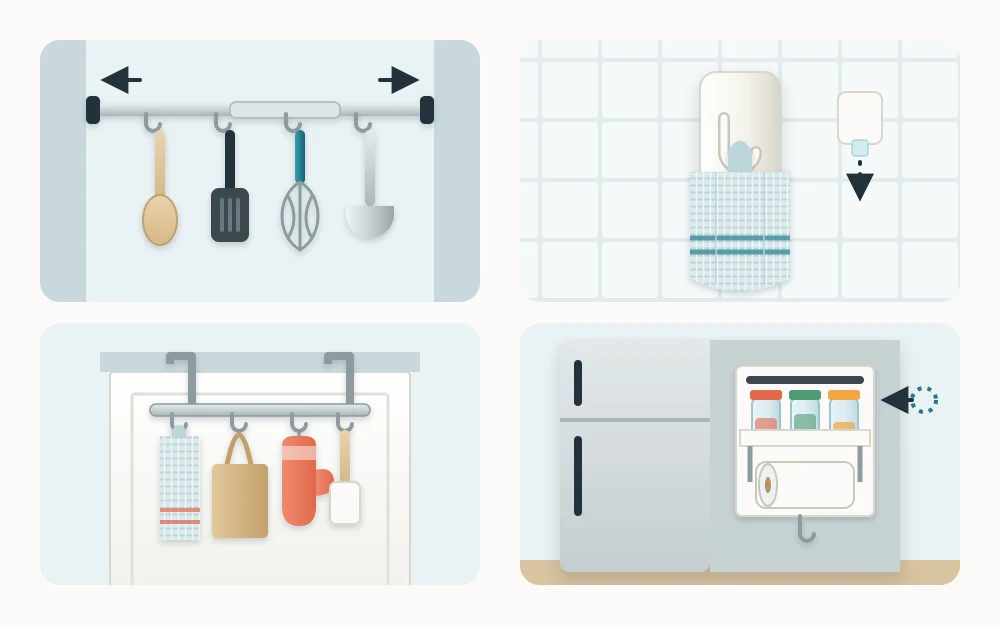
- Between two walls or the sides of a recess, a rod with hooks becomes a short rail for light utensils.
Measure the gap before buying, since each rod covers a set range of lengths. A rod holds only what its instructions say and only against firm, clean surfaces; check it now and then, because it can loosen.
Hooks and racks that hang without holes
Removable adhesive hooks and strips
Removable adhesive hooks suit light things: a dish towel, a pair of oven mitts, measuring spoons, a small brush. Hook-and-loop strips can hold a light caddy or a roll of bags inside a cabinet door.
They work only on the surfaces their instructions list, which often excludes textured walls, some paints and damp areas. Clean and dry the surface first, press for as long as the instructions say, and wait the stated time before hanging anything.
Good to know
Keep to the stated limit printed on the pack and use adhesive products for light items only. When you move out, remove each strip exactly the way its instructions describe; pulling it straight off the wall can take paint with it.
Over-door and magnetic racks
Hooks and racks that hang over the top edge of a door need no fixing at all. A full-size rack on a nearby closet door holds wraps, bags and dish towels; a small rack over a cabinet door can hold a trash bag roll or a cutting board.
The check is simple: hang it, load it and close the door. If the door no longer shuts fully, or the rack hits the shelves inside, try a slimmer one.
The exposed side of a refrigerator will often take a magnetic rack for light items such as paper towels or wraps. Test with a small magnet first, as not every appliance panel is magnetic, and keep the rack clear of the fridge’s vents and door swing.
Freestanding organizers inside the cabinets
You cannot move a fixed shelf, but you can change how the space around it is used. Shelf risers split a tall gap into two levels. Turntables bring the back of a deep shelf to the front. Stacking bins and handled baskets act as pull-out drawers in lower cabinets.
Measure the inside width, depth and height of each cabinet, and the door opening, before buying. The article on using height inside cabinets and on walls explains how to find the wasted space.
Removable shelf and drawer liners are worth adding at the start of a tenancy. They protect the surfaces you will be handing back and lift out when you leave. Choose a liner sold as removable or non-adhesive.
Furniture and countertop racks
When the cabinets are full, a rolling cart or an open shelving unit adds storage without touching the building. Check that it does not block a walkway or an appliance door, and secure any tall unit against tipping following the maker’s instructions.
On the counter, a two-level rack or a dish rack that sits over the sink can add a level where the layout allows. Use these sparingly, because the counter is also your work surface. For more on furniture and other cabinet substitutes, see the guide to organizing a kitchen that has few cabinets.
No-drill options at a glance
| Solution | Good for | Check first |
|---|---|---|
| Tension rod | Upright trays and lids, a light rail | Gap width, firm surfaces, rated use |
| Removable adhesive hook | Towels, mitts, small tools | Surface type and stated limit |
| Over-door rack | Wraps, bags, towels | Door still closes fully |
| Magnetic rack | Light items on the fridge side | Panel is magnetic, vents stay clear |
| Shelf riser or turntable | Dishes, bottles, deep shelves | Inside cabinet measurements |
| Cart or shelving unit | Overflow cookware and appliances | Walkways, door swings, tipping |
What to avoid in a rental
A few popular ideas can cost you part of a deposit:
- Permanent adhesives, including strong mounting tape and construction glue, which can pull off paint or a cabinet’s finish.
- Contact paper or stick-on coverings that are not sold as removable. Some bond harder over time, so test a hidden corner even with removable products.
- Anything that blocks a vent, whether on the fridge, the range hood, a microwave or a wall grille.
- Rods, hooks and racks near the cooktop. Keep them, and anything hanging from them, well to the side and away from the heat.
Storage that moves with you
The quiet benefit of a no-drill setup is that you own all of it. Risers, bins, rods, racks and carts pack into a box and go to the next home, where cabinet sizes will differ but most pieces will find a use.
That is a reason to favor adjustable items over ones sized to a single cabinet: expandable risers, rods with a wide range and bins in a few standard sizes. In a small rental, pair these tools with the strategy in the guide to making a small kitchen work, since owning less is the one fix no landlord can object to.
Frequently asked questions
How can I add kitchen storage without drilling holes?
Use things that grip, hang or stand: tension rods inside cabinets, removable adhesive hooks for light items, over-door racks, a magnetic rack on the fridge side, shelf risers and turntables on existing shelves, and a cart or shelving unit on the floor. Measure first and follow each product's instructions.
Do removable adhesive hooks damage paint?
They are designed not to when used on the surfaces their instructions list and removed exactly as directed. Damage usually comes from an unsuitable surface or from pulling the strip straight off. If you are unsure about a wall, test one hook in a hidden spot first.
Can I use contact paper in a rental kitchen?
Only a product sold as removable, and even then test a hidden corner, because some coverings bond harder over time and may not come off cleanly. A loose, non-adhesive shelf or drawer liner protects surfaces just as well and simply lifts out when you move.