How to Organize Dishes and Glasses in Kitchen Cabinets
Where plates, bowls, mugs and glasses should live and how to arrange each on the shelf: short stacks by size, glasses in front-to-back rows, and heavy pieces kept low.
Plates, bowls, mugs and glasses are handled more often than anything else in the kitchen. They come out at every meal and go back after every wash, so a poor arrangement costs you a little effort many times a day.
Deciding how to organize dishes and glasses starts with location, then moves shelf by shelf: the everyday set where it is easiest to reach, each type in its own stack or row, and the heavy and rarely used pieces placed with their weight in mind.
Choose the location first
Everyday dishes and glasses belong in the cabinet nearest the dishwasher or the drying rack. Unloading should be a matter of turning and reaching, not walking across the room with a stack of plates.
Stand at the open dishwasher or beside the rack and see which cabinet you can reach with one step or none. In most layouts that is the upper cabinet directly above or beside it. If that cabinet currently holds something else, swap them; few things in the kitchen are moved as often as the dishes.
If glasses are mostly filled at the refrigerator or the sink, a cabinet between the two is a good second choice for them. For how this fits with the rest of the room, see the walk-through on organizing kitchen cabinets step by step.
Put the everyday set on the lowest shelf
The lowest shelf of an upper cabinet is prime space: you can see into it and lift from it without stretching. It goes to the plates, bowls and glasses you use daily. Less-used pieces go on the shelf above, and special-occasion pieces higher still.
Not sure which pieces count as everyday? The guide to identifying your frequently used kitchen items gives a quick way to tell.
A deep lower drawer is an alternative that suits some households, especially where children set the table or where reaching overhead is difficult. Pegs or dividers in the drawer keep stacks from sliding when it opens and closes. Stacks of plates are heavy, so check the cabinet maker’s stated limit for the drawer.
Plates: short stacks, sorted by size
Stack plates by size, dinner plates in one stack and side plates in another. A single mixed tower means lifting small plates off large ones every time, usually with one hand.
Keep each stack short enough to lift comfortably as a whole, and short enough that taking a plate from the bottom third is not a struggle. How many that is depends on the plates and on you; heavy stoneware calls for shorter stacks than thin porcelain.
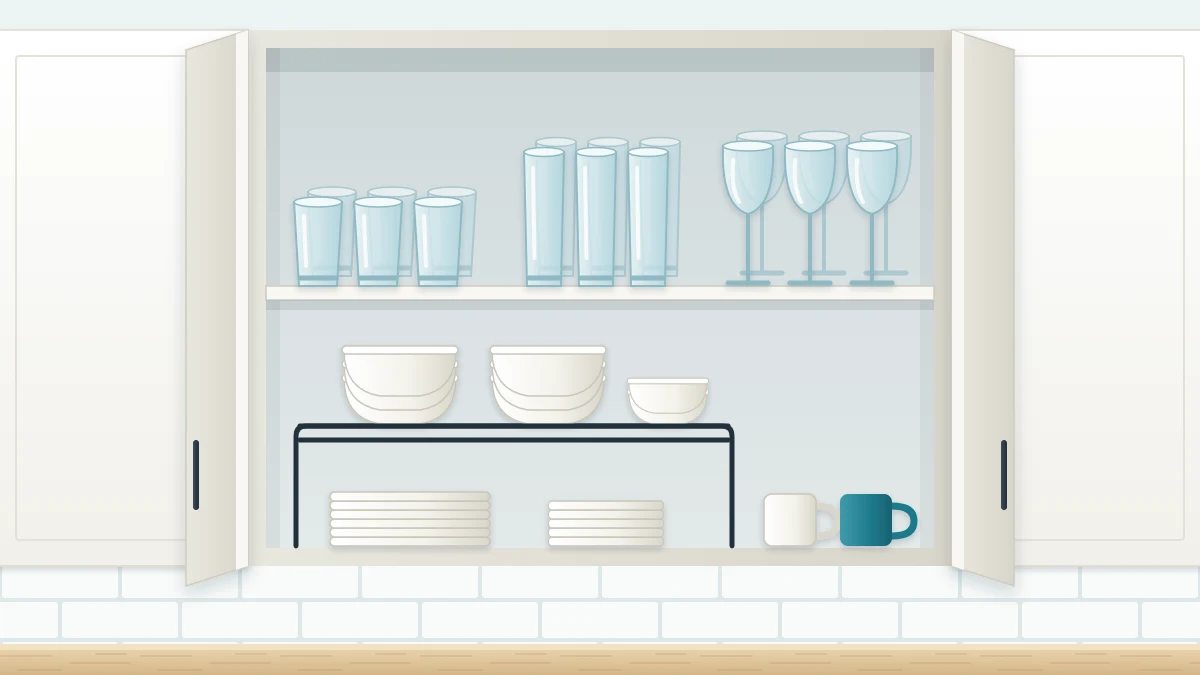
A shelf riser turns one tall shelf space into two levels: dinner plates below, side plates or bowls on top. Each stack then has its own floor and comes out without anything being moved. Measure the height between shelves and the height of your stacks first, and follow the riser’s stated limit.
Good to know
Dishes are heavy in quantity. Keep large stacks on lower shelves, put nothing heavy on the top shelf, and check the stated limit of the cabinet shelves and of any riser or hooks you add rather than guessing.
Bowls: nest only identical shapes
Bowls of the same shape nest closely and lift as one. Bowls of different shapes stacked together wobble, waste height and chip at the rims. Give each shape its own stack, even if that makes two short stacks instead of one tall one.
Wide, shallow bowls often sit better with the plates. Deep cereal or soup bowls can take the top of a shelf riser, where a short stack fits neatly.
Glasses: rows from front to back, by type
Arrange glasses in straight rows running from the front of the shelf to the back, one type per row: a row of water glasses, a row of juice glasses, a row of tall ones. Every type is then reachable from the front, and when the front glass is taken, the next of the same kind is right behind it.
The common alternative, one type across the front and another hidden behind, means reaching over glassware to get to more glassware.
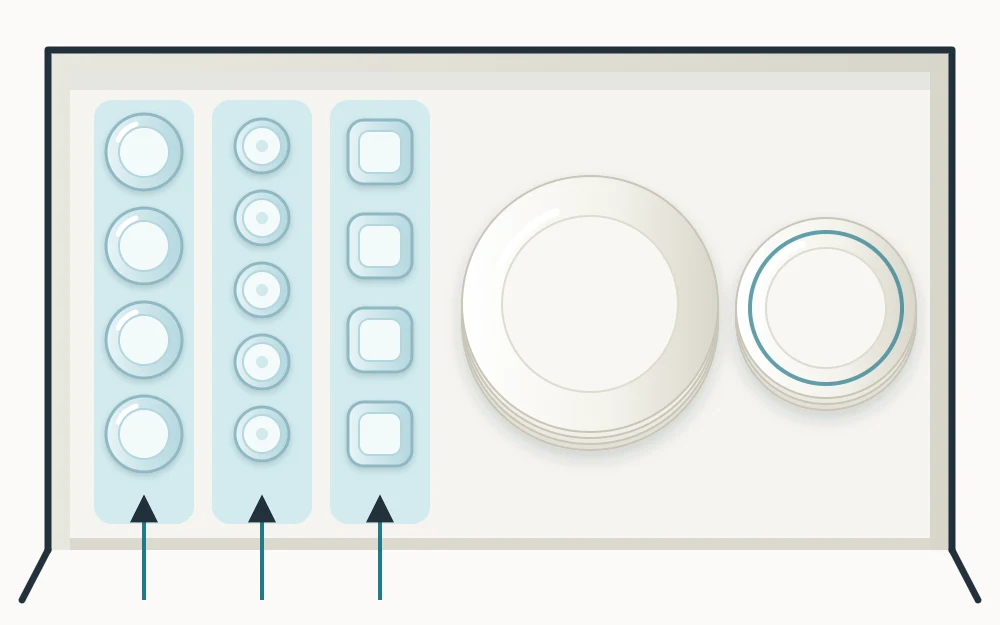
Rim up or rim down is a matter of preference and of the shelf surface. Rim down keeps dust out of the glass; rim up keeps the thinnest edge of a delicate glass off the shelf. On a lined or ridged shelf, see which way your glasses sit most steadily and choose that.
Tip
Leave a finger’s width between rows. Glasses packed rim to rim knock together each time one is taken out.
Mugs: a riser or hooks
Mugs are short, so a shelf of them leaves a band of empty space above. A shelf riser doubles the mug space in the same footprint. Under-shelf hooks are the other option, hanging mugs by the handle beneath a shelf, with more mugs or small plates standing below.
With hooks, follow the product’s stated limit and fitting instructions, and check that hanging mugs clear both the items below and the closing door. Stacking mugs directly inside each other tends to wedge them and wear the rims, so it is better kept for mugs designed to stack.
Stemware and delicate pieces
Wine glasses, thin tumblers and anything fragile go in a single layer with space around each piece. Do not stack them and do not crowd them. A higher shelf suits them if they are used occasionally, since they are light; just keep them toward the front where you can grip the bowl of the glass rather than the stem.
Heavy serving platters and large bowls are the opposite case. They belong on a lower shelf or in a lower cabinet, however rarely they are used.
How many to keep in the cabinet
The cabinet near the dishwasher does not have to hold every dish you own. Keep enough of the everyday set there for the household between washes, with a few extra, and store the rest as backstock: on a top shelf if light, in a lower cabinet or another room if heavy.
The shelf should have some slack once it is full. If putting away the last glass means rearranging the others, the shelf is holding too many.
In a kitchen with only one or two upper cabinets, trimming the working set matters even more. The guide to organizing a small kitchen covers how to prioritize when cabinet space is tight.
Frequently asked questions
Which cabinet should dishes go in?
In most kitchens, the cabinet closest to the dishwasher or drying rack, because that is where dishes are put away several times a day. Stand at the open dishwasher and pick the cabinet you can reach without walking. A deep lower drawer nearby can work as well if that suits your household.
Should glasses be stored rim up or rim down?
Either works, and it comes down to preference and your shelf surface. Rim down keeps dust out; rim up keeps a thin, delicate edge off the shelf. Try both and choose the way your glasses stand most steadily on the shelf or liner you have.
How high should a stack of plates be?
There is no single number, because plates differ in thickness and how heavy they are. Keep each stack short enough that you can lift the whole stack comfortably and take a plate from low in the stack without strain. Use a shelf riser to split one tall stack into two short ones.