How to Organize Pot Lids So You Can Find the Right One
Match every lid to a pot, let go of the orphans, then pick from six ways to store lids on edge, sorted by size and kept right beside the cookware they fit.
Pot lids resist every ordinary way of storing things. They are round, so they roll. They have a knob or handle in the middle, so they will not stack flat. And they are nearly the same size as each other, so the one you pull out is often one size too small for the pot on the stove.
The answer to how to organize pot lids has two parts: own fewer of them, and store the ones you keep on edge, sorted by size, next to the cookware they fit. Which holder you use depends on the space you have, and several cost very little.
Why lids end up in a heap
Most cabinets are built for things that sit flat on a shelf. A lid placed flat takes the footprint of a whole pan while using almost none of the height above it. Pile several and the knobs make the pile unstable, so it slides the first time a pan is pulled out beside it.
Lids also get separated from their pots as soon as the pots are nested. Once that happens, every lid is loose, and loose round objects travel to the back of the cabinet.
Reduce first: match every lid to a pot
Take all the lids and all the cookware out and pair them on the counter. This takes a few minutes and usually produces three small discoveries:
- Orphans. Lids whose pots are long gone. Let them go.
- Shared lids. One lid often fits two pans of the same diameter, such as a saucepan and a frying pan. Keep one lid for the pair and note which pans it serves.
- Lids you never use. If a pan is always used uncovered, its lid can move to a less convenient spot.
What remains is the working set. Count it and line it up from largest to smallest, because that number and the largest diameter decide which storage method will fit.
Six ways to store pot lids
An upright rack or file-style divider on a shelf
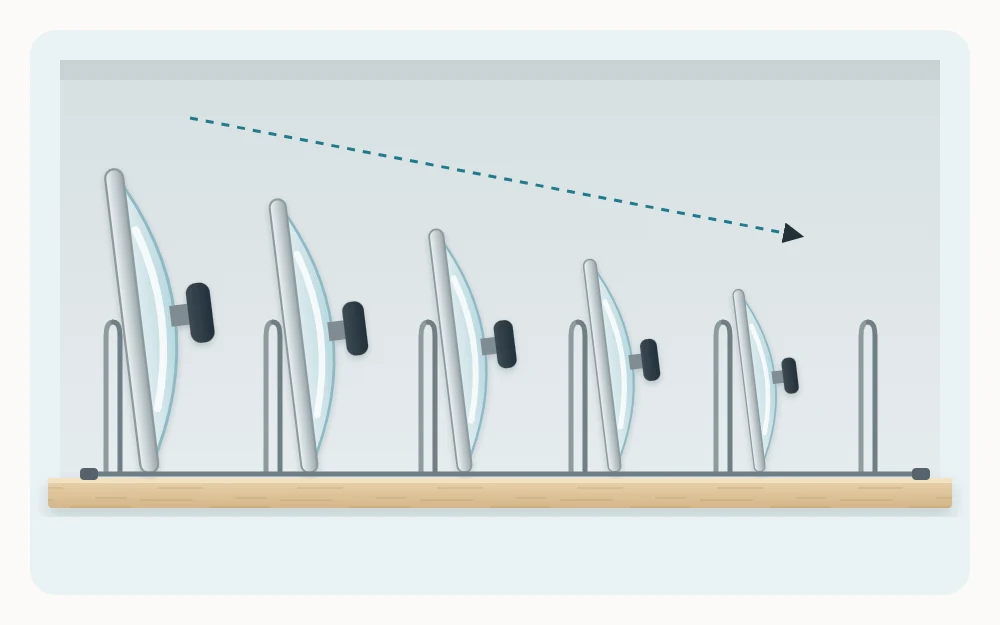
A lid rack holds each lid on edge in its own slot, like files in a holder. It sits on a cabinet shelf beside the pans and needs no fixing. Check that the shelf height clears your largest lid standing upright, and that the slots are wide enough for the knobs.
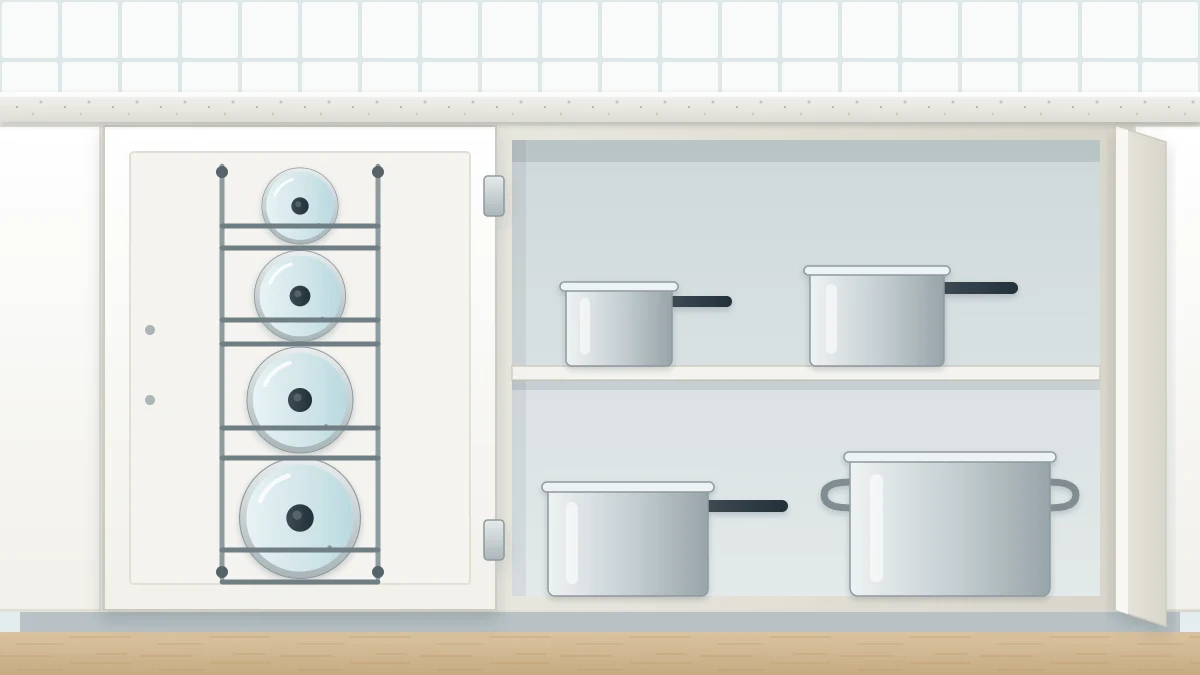
A rack inside a cabinet door
A slim rack on the inside of a door uses space that otherwise holds nothing. It suits light lids only. Before fitting one, hold a lid in position and close the door slowly: it has to clear the shelf edges and whatever is stored on them.
A narrow bin
A bin a little narrower than your smallest lid keeps a row of lids standing on edge, leaning lightly on each other. It slides out like a drawer, which helps on a deep lower shelf. A layer of non-slip liner in the bottom keeps metal lids from skating.
A divided section of a deep drawer
If your cookware lives in a deep drawer, give lids a strip along one side or across the front, separated by a divider, and stand them on edge. They stay beside the pots and are visible from above. The guide to organizing deep drawers shows how to plan the rest of the drawer around that strip.
A tension rod across the front of a drawer
A short tension rod set across the drawer, a little way behind the drawer front, creates a slot. Lids stand upright in it, held between the rod and the front. Follow the rod’s instructions, press it firmly between the drawer sides, and check that it stays put when the drawer is opened and closed.
Upside down on its own pot
When pots are stored singly rather than nested, each lid can sit inverted on its pot, knob down. Nothing to buy, and lid and pot can never be separated. The cost is space, since pots stored this way cannot be stacked inside each other.
How the methods compare
| Method | Space needed | Best for |
|---|---|---|
| Upright rack on a shelf | A strip of shelf as tall as the largest lid | Most cabinets; mixed lid sizes |
| Door-mounted rack | Clearance between door and shelves | A few light lids; small kitchens |
| Narrow bin | A lane on a deep shelf | Deep lower cabinets |
| Divided drawer section | One side of a deep drawer | Cookware kept in drawers |
| Tension rod in a drawer | The front few inches of a deep drawer | A quick, low-cost fix |
| Inverted on its pot | Room to store pots singly | Small sets; roomy cabinets |
Sort by size and keep lids beside their cookware
Whichever holder you choose, arrange the lids by diameter, largest at the back or at one end. A consistent order means you learn the position of each lid within days and stop pulling out two to compare.
Keep the lids in the same cabinet or drawer as the pots, or in the one directly beside it. A lid stored across the kitchen will be left off the pan or left on the counter. How the pans themselves are arranged is covered in the guide to organizing pots and pans in a cabinet.
Tip
Put the lid shared by two pans in the easiest slot to reach. It is used twice as often as any other.
Take care with glass lids and door racks
Glass lids can chip or crack when they knock together. Avoid loose piles, give each glass lid its own slot, and do not wedge one tightly between metal lids. For oven or dishwasher use, follow the manufacturer’s markings on the lid.
Good to know
A door-mounted rack loads the door and its hinges. Follow the product’s fixing instructions and stated limit, and keep to light items; heavy cast iron or thick glass lids are better on a low shelf.
Food-container lids are a different problem
The lids for leftover containers are small, flat, numerous and easy to mismatch, so the methods above do not carry over. They are handled in the guide to organizing food storage containers.
Frequently asked questions
What is the simplest way to store pot lids?
With no purchase at all, turn each lid upside down on its own pot, provided the pots are not nested. If you need the pots to nest, a narrow bin or an upright rack on the same shelf keeps the lids on edge and sorted by size with very little setup.
Can I store pot lids on the inside of a cabinet door?
Often yes, for a few light lids. Check first that the door still closes with a lid in place and that it clears the shelf edges and their contents. Follow the rack's fixing instructions and stated limit, and keep heavy lids on a low shelf instead.
How many pot lids do I really need?
Usually fewer than you own. Pair every lid with a pan, and where two pans share a diameter, one lid can serve both. Lids with no matching pot can go. The working set that remains is what your storage needs to hold, so count it before choosing a holder.