Deep Kitchen Drawer Organization for Pots, Bowls and Containers
What deep lower drawers are best for and how to stop their contents shifting and burying each other, using deep dividers, pegboards, upright racks and bins, with a table matching contents to dividers.
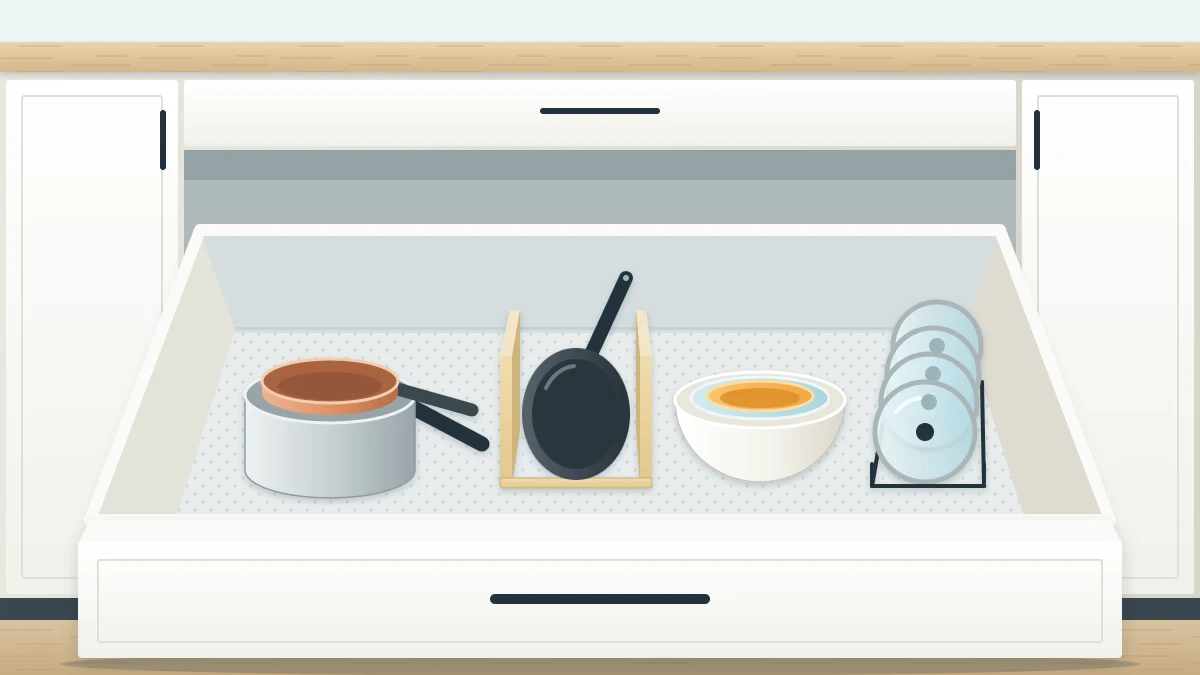
Deep lower drawers hold a lot, which is exactly how they go wrong. With nothing to separate the contents, pans slide into bowls, lids sink to the bottom and the drawer becomes a pile you dig through from above.
Deep kitchen drawer organization comes down to one aim: every item can be lifted out without moving another. Getting there means choosing what the drawer is for, then adding the dividers, pegs or racks that stop things shifting when it opens and closes.
What deep drawers do well
A deep drawer brings its whole contents out to you. Instead of kneeling to reach the back of a lower cabinet, you look down into the drawer and see everything at once. When the drawer extends fully, the back is as easy to reach as the front.
That makes deep drawers a good home for heavy and bulky items, which are easier to lift from waist or knee height than from a high shelf. Good candidates include:
- Pots and pans
- Mixing bowls and colanders
- Food storage containers and their lids
- Small appliances that are used weekly, cooled and unplugged before they go in
- Everyday plates and bowls, with a peg system or dividers so stacks do not slide
One drawer rarely suits all of these. Pick one category per drawer where you can, and place it by use: cookware near the stove, dishes near the dishwasher or the table, containers near where leftovers are packed.
The problem to solve: shifting and burying
Shallow drawers fail by tangling. Deep drawers fail in two other ways. Contents shift each time the drawer moves, so a neat arrangement drifts into a heap. And because there is height to spare, things get dropped on top of other things until the bottom layer is buried.
Both have the same cure: divide the floor of the drawer so each group has a fixed footprint, and use the height on purpose, with nested sets or items on edge, rather than by accident.
Tools that hold things in place
Measure the inside width, depth and height of the drawer before choosing anything, and note any rails or cutouts at the sides. Then pick from these, by type:
- Adjustable deep dividers. Tall panels that run front to back or side to side and lock at the width you set. They split the drawer into bays.
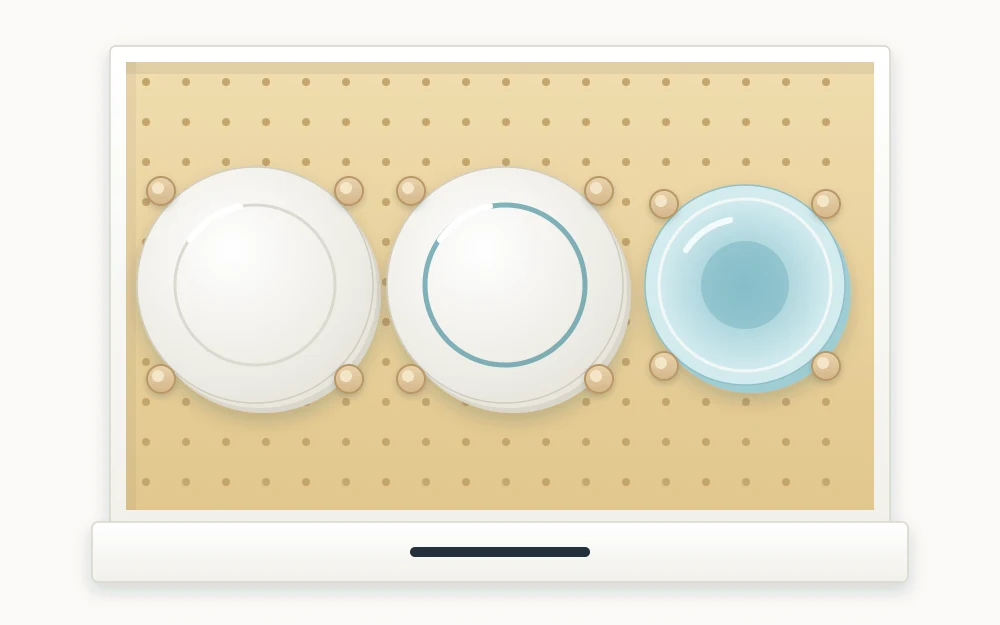
- Pegboards with movable pegs. A base panel with a grid of holes and upright pegs that you position around each stack to stop it sliding.
- Upright racks. Slotted racks that hold lids, frying pans, cutting boards and baking sheets on edge.
- Bins. Open-topped bins that subdivide the drawer for smaller things and lift out as a group.
- A non-slip liner. A simple base layer that reduces sliding and protects the drawer floor.
For shallow drawers the dividers and the logic are different; the general guide on how to organize kitchen drawers covers those.
Arrange so nothing has to be moved
With the tools chosen, set the drawer out by a few rules.
- One layer of nested sets. Nest pans or bowls of the same kind by size, largest at the bottom, and keep each nest in its own bay. A nest of three is one lift to the piece you want; a random stack of unrelated things is several.
- Flat things on edge. Lids, frying pans, boards and trays stand in a rack so each one pulls straight up.
- Most used at the front. The front of the drawer is reached with the drawer half open. Put daily pieces there.
- Leave some slack. If items have to be fitted together like a puzzle, the arrangement will not last a week.
Lids need their own system rather than sitting on their pans, and how to nest, hang or file cookware is its own subject, covered in the guide to organizing pots and pans.
Tip
Before fitting dividers, set the contents out in the empty drawer and open and close it a few times. Where things slide tells you where a divider or peg is needed.
What suits each kind of drawer
| Drawer contents | Divider that suits | How to arrange |
|---|---|---|
| Pots and pans | Adjustable deep dividers, upright rack | Nested by size; frying pans and lids on edge |
| Plates and bowls | Pegboard with movable pegs | Low stacks, pegs close around each |
| Mixing bowls | Deep dividers, non-slip liner | One or two nests, largest at the bottom |
| Food containers | Bins, upright rack for lids | Bases nested by shape; lids filed on edge |
| Small appliances | Non-slip liner, one bin for attachments | Single layer, cords coiled loosely |
Containers and lids are the hardest category to keep in order; the guide to food storage container organization goes through matching, reducing and filing them.
Keep heavier drawers lower
In a stack of drawers, put the heaviest contents in the lowest one. Cast iron, a set of pots or a full stack of dinner plates is easier to lift from a low drawer, and keeping weight low is the sensible default for any storage.
Lighter categories, such as food containers or plastic mixing bowls, suit the drawer above. If you have only one deep drawer, give it to whichever heavy category is causing the most trouble elsewhere.
Respect the drawer’s limit
Dishes and cookware are heavy, and a deep drawer makes it easy to load more than the slides were built for. The drawer itself tells you when that has happened. If it sags, sticks, scrapes or will not close smoothly, it is carrying too much, so lighten it.
Good to know
The limit for a drawer is set by its maker and depends on the slides and the cabinet. This guide does not guess it. Check the cabinet or hardware maker’s documentation, and if you cannot find a figure, load the drawer conservatively and watch how it moves.
Splitting a category across two drawers is often the fix: daily pans in one, the larger pots used less often in another. A drawer that glides shut with one hand is carrying a load it can manage, and it is also the drawer people actually put things back into.
Frequently asked questions
What should be stored in deep kitchen drawers?
Heavy and bulky items that are awkward on shelves: pots and pans, mixing bowls, food storage containers, small appliances and everyday plates and bowls. Try to give each drawer one category and place it near where those items are used, such as cookware close to the stove.
How do I stop plates from sliding in a drawer?
Use a pegboard base with movable upright pegs, positioned snugly around each stack, or deep dividers that create a bay for each stack. A non-slip liner underneath helps too. Keep stacks low so they sit below the top edge of the drawer and lift out easily.
How much can a deep drawer hold?
That depends on the slides and the cabinet, and the maker's documentation is the only reliable source for the limit. As a practical sign, a drawer that sags, sticks or will not close smoothly is overloaded. Move some of the contents to another drawer.