How to Organize Kitchen Utensils: Drawer, Crock or Rail
Sort your spatulas, spoons and gadgets into three groups, then compare the three homes for them: a divided drawer, a counter crock and a wall rail, with a mixed setup that suits most kitchens.
Spatulas, spoons and tongs multiply quietly. A set arrives as a gift, a second whisk comes home from a sale, and soon the drawer jams on a ladle every time you open it. Working out how to organize kitchen utensils is less about buying a holder and more about two decisions: which tools you really use, and where each group should live.
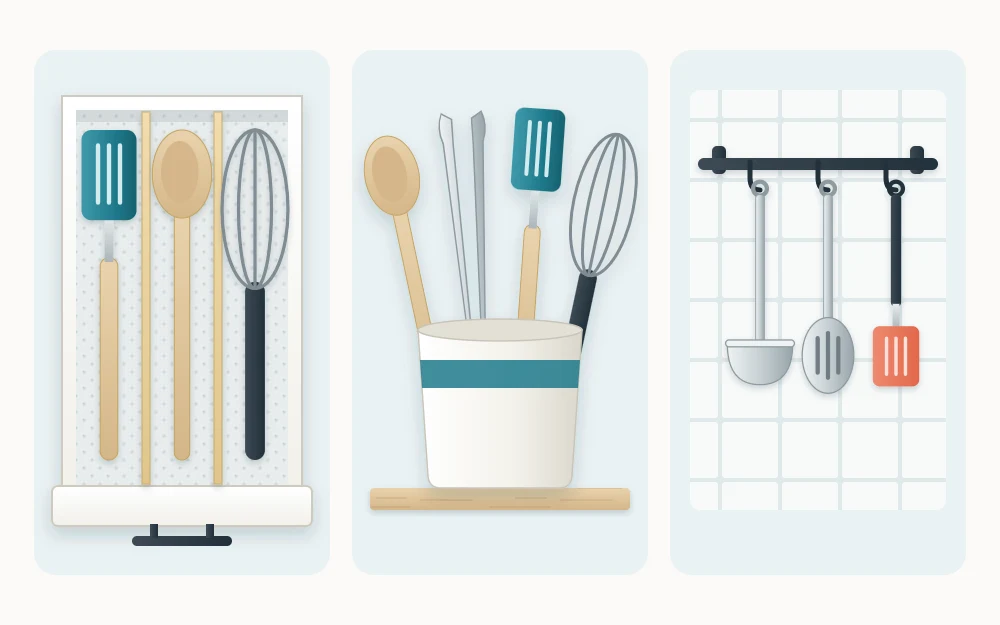
There are three common homes for utensils: a divided drawer, a crock on the counter and a rail on the wall. Each has a clear strength and a clear cost, and most kitchens end up using two of them together.
Sort before you choose a home
Empty every utensil onto the counter, including the ones in the back of other drawers. Then sort them into three groups.
- Cooking tools: spatulas, turners, wooden spoons, ladles, tongs and whisks. These are used at the cooktop, usually with one hand while the other holds a pan.
- Prep tools: peelers, graters, measuring spoons and cups, a can opener, kitchen scissors. These are used at the counter where you chop and mix.
- Occasional gadgets: anything that comes out a few times a year, such as a baster, a melon baller or a set of cookie cutters.
Now reduce the duplicates. Lay the same kind of tool side by side and keep the ones you reach for first. Two spatulas of different shapes earn their place; five of the same shape do not. Anything cracked, melted at the edge or missing a part can go. The fewer tools you keep, the easier each of the three homes becomes.
The drawer: hidden and tidy
A drawer keeps the counter clear and the tools out of sight. It suits flat tools best: turners, peelers, measuring spoons and anything short enough to lie in a lane without catching the frame above.
A drawer only works with drawer dividers. Without them, every tool slides to the back on the first pull. Give each kind of tool its own lane, long tools along the depth of the drawer and small ones in shorter compartments at the front. Measure the inside of the drawer, including its height, before choosing dividers; a whisk or ladle that is taller than the drawer is the usual reason a drawer sticks.
Position matters as much as the dividers. Cooking tools belong in a drawer near the stove, and prep tools in one near the main work surface. The broader method for lanes, liners and what goes in which drawer is covered in the guide on how to organize kitchen drawers.
The crock: fastest to grab
A crock or upright holder on the counter is the quickest home there is. Nothing to open, and long-handled tools that fit badly in a drawer stand in it easily. Its cost is counter space, and it is the one home that is always on show.
Two things keep a crock useful. First, do not overfill it. If you have to hold three tools back to pull out one, the crock is holding too much, and the extra tools should move to a drawer. Second, choose its spot with care. Set it to the side of the cooktop, within reach, rather than right beside a burner, where handles can scorch or melt and grease settles on everything.
A heavier, wider crock tips less than a tall narrow one. If the counter is already crowded, read the guide to deciding what stays on the countertop before giving a crock a permanent place.
The wall rail: using empty height
A rail with hooks moves tools off the counter and out of the drawer by using the wall. Each tool hangs separately, so nothing tangles and you can see the whole set at a glance.
The limits are practical. A rail only works for tools that have a hanging loop or a hole in the handle. It also needs sound fixing: follow the instructions that come with the rail, respect its stated limit, and use fixings that suit your wall type. If you are not sure what the wall is made of, ask someone qualified before drilling.
Place the rail on a stretch of backsplash to one side, not directly over the burners, where you would have to reach across heat and where anything that can burn or melt does not belong. Rails are one of several ways to use walls and doors; the guide to vertical storage in the kitchen covers the others.
Drawer, crock or rail compared
| Home | Best for | Strength | Watch for |
|---|---|---|---|
| Divided drawer | Flat and short tools | Clear counter, hidden from view | Needs dividers and a drawer near the stove |
| Counter crock | Long-handled daily tools | Fastest to grab | Takes counter space; easy to overfill |
| Wall rail | Tools with a hanging loop | Uses vertical space | Needs sound fixing and a spot away from the burners |
A mixed setup that suits most kitchens
You do not have to pick one home. In most layouts a combination works better than any single option.
- Choose the five or six tools you use nearly every day. For many households that is a turner, a wooden spoon, tongs, a ladle, a whisk and a silicone spatula.
- Give those a crock or a rail to the side of the cooktop.
- Put the rest of the cooking and prep tools in a divided drawer, sorted by kind.
- Move the occasional gadgets to a bin on a higher shelf or in a less convenient cabinet, so they stop crowding the prime space.
Tip
If you are unsure which tools count as daily, put everything in one box for two weeks and move a tool to the crock only when you use it. What is still in the box at the end is drawer or bin material.
Knives and other sharp tools
Sharp tools need a home of their own, separate from the spoons and spatulas. Keep knives in a block, in an in-drawer knife holder, on a properly mounted magnetic strip or in blade guards. Never leave them loose in a drawer, where a hand reaching for a peeler meets an edge first.
The same thinking applies to graters, peelers with exposed blades and the cutting discs of small appliances. Give them a fixed compartment, blade side down or covered, so everyone in the household knows where the sharp things are.
Frequently asked questions
Is it better to keep utensils in a drawer or in a crock?
It depends on the tool and the kitchen. A drawer with dividers suits flat, short tools and keeps the counter clear. A crock suits long-handled tools used every day and is quicker to reach. Many kitchens use both: a small crock for daily tools and a divided drawer for the rest.
How many utensils should go in a crock?
Only as many as you can pull out one at a time without holding the others back. For most households that is around five or six everyday tools. If the crock is packed tight or tools tangle, move the less used ones to a drawer.
Where should a utensil rail go?
On a clear stretch of wall or backsplash to the side of the cooktop, within reach but not directly over the burners. Fix it as its instructions describe, with fixings suited to your wall type, and hang only tools that have a loop or hole in the handle.